Search for an internal linking strategy and you get a list of tactics: use descriptive anchors, fix orphan pages, link related posts. Every list has the same items. None of them is a strategy.
A strategy is a small set of decisions you make on purpose, before you touch a single link. The useful part is that the controlled studies, SearchPilot’s split tests and Zyppy’s analysis of 23 million links, are unusually clear about which decisions move rankings and which popular tactics waste your time. This is the version built on that evidence: four decisions, in order, plus the tactics worth dropping.
- An internal linking strategy is link-graph design under a constraint: finite authority, finite reader attention, and a hierarchy Google has to be able to read. You cannot link everything to everything.
- Fix structure first. The largest measured internal-linking win on record came from making buried pages reachable, not from adding more links.
- Route links from where authority actually lives, your homepage and pages with real backlinks, not from whichever page happens to get traffic.
- Make backward linking a process. An InLinks study of 5.112 sites found about 82% of internal link opportunities go unused, almost all of it in old posts nobody reopens.
- Drop the folklore: exact-match internal anchors, first-link-priority tricks, and nofollow sculpting are not strategy, they are wasted effort.
A strategy is how you spend a fixed budget
Start with the constraint, because the constraint is what makes this a strategy rather than a checklist.
Your site has a finite amount of internal authority to pass around. It comes from the links other sites point at you and from the trust your homepage has built over time. Every internal link you add divides that authority a little further. Reader attention is finite too: click-through on links drops sharply the further down a page they sit.
So you cannot link everything to everything, and you should not want to. John Mueller has put this plainly: if every page links to every other page, Google cannot tell which pages you consider important, and the hierarchy collapses. A link that points everywhere points nowhere.
That reframes the whole job. Internal linking strategy is not “add good links”. It is deciding, deliberately, where a limited budget goes: which pages you are trying to rank, which pages have authority to spend, and how you connect them without flattening your own hierarchy. The four decisions below are that allocation, in the order they pay off. The case for why internal linking earns the effort at all, with the controlled-study evidence, is in why internal links matter more than you think.
Decision 1: Fix the structure before you touch in-body links
The instinct is to start adding contextual links inside articles. The evidence says start one level up, with structure.
SearchPilot’s most cited internal linking test was on the retailer Iceland. They added links from mid-level category pages down to sub-category pages that had previously been reachable only through the main navigation. Organic traffic rose about 25%. SearchPilot were explicit about the reason: the win was not link count, it was reachability. Pages that were effectively buried got a real path, for the crawler and the reader at once.
That is the first decision, and it is structural. Map how many clicks it takes to reach your important pages from the homepage. Pages buried four or five clicks deep, or reachable only through a search box or deep pagination, underperform no matter how good they are. Pulling them up to within two or three clicks is the highest-leverage move available. The “three clicks” figure is an SEO community heuristic rather than a Google rule, but the direction is sound: shallower is better.
In practice this means a hub-and-spoke shape. One hub page per topic, supporting articles that link up to it and across to their genuine siblings. The framework section of the pillar guide walks through how to build that. Get the structure right once and every in-body link you add afterwards lands on a foundation that already makes sense.
Decision 2: Route links from where authority actually lives
Once the structure holds, decide where the authority comes from. This is where most strategies go wrong: they tell you to link from your highest-traffic pages. Traffic is not authority.
A page can rank for one easy query and collect clicks without having any real authority to pass on. The authority worth routing concentrates in three places: your homepage, the pages other websites have linked to, and older cornerstone content that has earned trust over years.
The mechanic is concrete. Open Google Search Console, go to the Links report, and look at “Top linked pages” under external links. The pages other sites link to most are your genuine authority sources. List your priority pages separately, the ones you actually need to rank. Then make sure each priority page receives an in-content link from at least one real authority source. Where it does not, that is your highest-value missing link.
One honest caveat keeps this from being oversold. SearchPilot ran a test that added related-article links on a content hub, and the pages that received the new links showed no measurable traffic change, while the pages that gave the links gained more. Internal linking is not a clean pipe that pumps ranking power into a target. Part of why it works is the structure and context of the page doing the linking. Route deliberately, but do not expect a single inbound link to carry a page that cannot compete on its own.
Decision 3: Make backward linking a process, not a good intention
An InLinks study of 5.112 sites surfaced the number that should shape your workflow: about 82% of internal link opportunities go unused, counting only the in-content links that carry real SEO weight. Pages that clearly belong linked together simply are not.
It is not a knowledge problem. Everyone agrees old posts should link to relevant new ones. It is a process problem. Teams link forward, a new post ships with links out to older content, and then the older posts are never reopened, because editing finished work does not feel like progress.
The fix is a rule attached to publishing. A post is not done when it goes live. It is done when the backward links exist. Concretely: every time you publish, open two or three older posts in the same cluster and add a link to the new piece.
Here is what that looks like on a real site. You publish a new post on anchor text. Before you close the tab, you find the three most relevant existing posts: the cluster hub, an older post that mentions anchor text in passing, and the post most likely to rank for a nearby query. You add one contextual link from each, pointing at the new post, with anchor wording that fits the sentence it sits in. Ten minutes. Done at publish time, it never becomes a backlog. Skipped once, it becomes part of the 82%.
Decision 4: Anchor text, and three myths to drop
Anchor text is where internal linking strategy collects the most outdated advice. The working rule is short: write anchors that describe the destination, and let the wording vary naturally across links. Zyppy found anchor text variety was the single strongest signal in their data, stronger than link count. Writing anchors the way a person would naturally refer to a page produces that variety for free.
Three popular tactics are worth actively dropping:
- Exact-match anchor stuffing. Repeating your target keyword as the anchor on every internal link does not move rankings. John Mueller said the effect of anchor text on internal links specifically is “not something where you would see a visible effect in search”. It also reads like a machine wrote it.
- First-link-priority tricks. The idea that Google counts only the first link to a URL on a page, so you must engineer which link comes first, traces to a 2008 experiment that Google never confirmed and has never described as a current rule. Do not build a strategy on it.
- Nofollow sculpting. Adding
nofollowto internal links to conserve authority for other links has not worked since Google changed that behaviour around 2008. The withheld authority evaporates, it is not redirected.
Anchor text strategy is genuinely that simple: describe the destination honestly, let variety happen, and ignore the folklore. The anchor text section of the pillar guide covers link density alongside it.
What a deliberate strategy refuses to do
A strategy is defined as much by what it rules out. Four things a deliberate internal linking strategy does not do:
- It does not link everything to everything. Indiscriminate linking destroys the hierarchy Google reads. If every page is linked from every page, no page stands out as important.
- It does not count sitewide links as strategy. Navigation and footer links appear on every page, and Google discounts boilerplate that repeats site-wide. They have their place, but they are not where your deliberate authority routing happens. In-content editorial links are.
- It does not chase a link-count number. There is no target like “10 internal links per post”. Zyppy’s data shows gains flattening past the first 10 or so inbound links and the relationship turning negative past roughly 45, and even that decline is mostly a sign of boilerplate links rather than a quantity penalty. Connect genuinely related pages and the count takes care of itself.
- It does not point authority at weak pages and expect a rescue. Internal linking is a multiplier on content that can already compete. A thin page does not start ranking because you aimed links at it.
Putting it together: a worked example
Take a real shape: a WordPress blog with 60 published posts, loosely covering three topics, with no deliberate internal linking so far. The strategy applies in order.
- Structure, done once. Group the 60 posts into their three topics. For each topic, pick the strongest existing post as the hub, or write one. Link every post in a topic up to its hub, and the hub down to each post. This alone gives Google three clear clusters where it previously saw 60 loose pages.
- Authority routing, done once. Check the Search Console Links report. Say three older posts hold almost all the external backlinks. Add a contextual link from each of those three to the hub or priority page of its topic. The site’s accumulated authority now flows toward the pages meant to rank.
- The habit, ongoing. From now on, every new post ships with links up to its hub and out to two or three siblings, and you edit two or three older posts to link back to it. About ten minutes per publish.
Steps 1 and 2 are a weekend of work, done once. Step 3 is the strategy, the part that compounds. A year of step 3 builds a tighter, more deliberate link graph than most sites ever reach, and it costs ten minutes a week.
How TamRank fits into this
The strategic decisions in this guide remain yours. You decide which pages matter, which relationships are useful to a reader and where a link genuinely belongs. TamRank Free provides the underlying site view by mapping contextual internal links and surfacing orphaned content.
TamRank PRO helps when the number of possible improvements becomes difficult to manage. It connects a link problem to Search Console evidence, page importance and confidence, then places the most relevant actions in a work queue. This keeps the strategy focused on pages that can benefit rather than pages that merely have the lowest count.
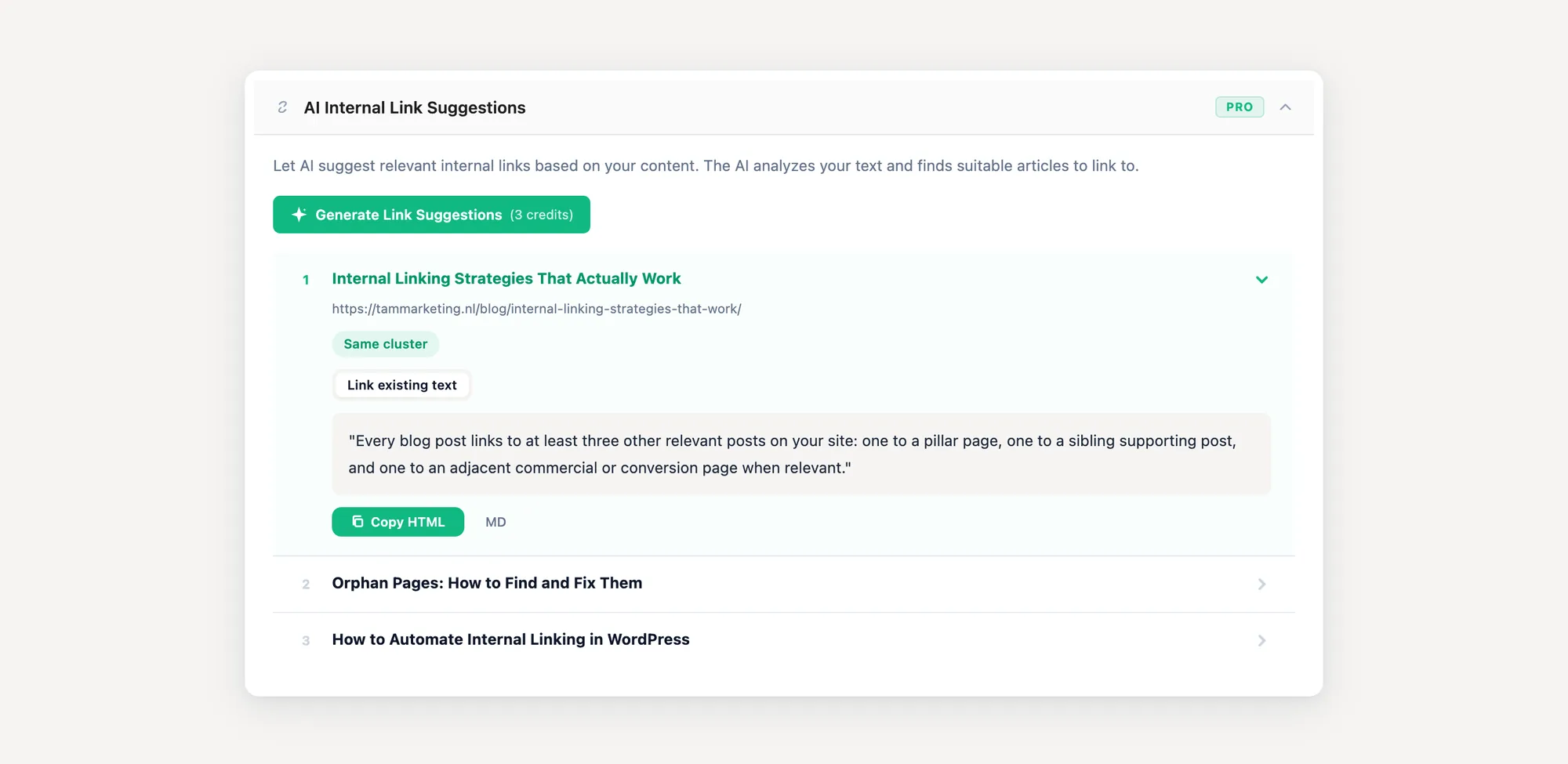
AI Internal Link Suggestions can then propose a relevant target and anchor text while you edit. Nothing needs to be inserted blindly. You keep the editorial decision and TamRank removes the repetitive search work. See how the PRO workflow works.
What people ask
What is the difference between an internal linking strategy and just adding links?
Adding links is a reflex: you link whatever comes to mind while writing. A strategy is a set of decisions made in advance, which pages you are trying to rank, which pages hold authority to pass on, and how you connect them, so every link is deliberate. The difference shows up over months, as a site with a readable hierarchy versus a tangle.
What is the most important internal linking decision?
Structure. The largest measured internal-linking result on record, a SearchPilot test on the retailer Iceland, came from making buried pages reachable in fewer clicks, not from adding more links. Fix how pages connect at the structural level before you optimise individual in-body links.
Does anchor text matter for internal links?
Descriptive, varied anchor text helps Google understand what a page is about, and Zyppy’s data found anchor variety was a strong signal. But exact-match keyword stuffing in internal anchors does not move rankings: John Mueller said it has no visible effect in search. Write anchors a reader would understand out of context and stop there.
How many internal links should a page have?
There is no fixed number. Zyppy’s data shows gains flattening after roughly the first 10 inbound internal links and turning negative past about 45, but that decline mostly reflects boilerplate navigation links rather than a penalty for quantity. Connect genuinely related pages with in-content links and the count is not something you need to manage.
How do I find which pages have authority to link from?
Open Google Search Console, go to the Links report, and look at “Top linked pages” under external links. Those are the pages other sites point at, which means they hold real authority to pass on internally. Your homepage and long-standing cornerstone posts belong on that list too.
The bottom line
An internal linking strategy is four decisions, not a tactic list. Fix the structure so important pages are reachable. Route links from where authority actually lives. Make backward linking a process attached to publishing. Write descriptive, varied anchors and ignore the folklore around them.
None of it is complicated, and that is the point. The reason it works when most internal link building does not is that it is grounded in what the studies measured, and disciplined about what to leave out. The complete internal linking guide covers the framework and the audit steps in full. Pair it with these four decisions and you have a strategy rather than a habit of adding links.
Sources
- SearchPilot, internal linking SEO split-test case studies, including the Iceland internal linking test and related-article test. SearchPilot case studies.
- Cyrus Shepard (Zyppy), “23 Million Internal Links: SEO Case Study” (2023). zyppy.com/seo/seo-study.
- InLinks, “82% of Internal Linking Opportunities Missed,” case study of 5,112 websites (2022). inlinks.com.
- John Mueller (Google), on internal anchor text and “visible effect in search,” Webmaster Central hangout, 2020. Reported by Search Engine Journal.
- “First Link Priority: Is It A Google Ranking Factor?” Search Engine Journal.
- Matt Cutts, “PageRank sculpting” (2009). mattcutts.com.

