Every internal linking guide gives the same instruction: optimise your anchor text. Use descriptive, keyword-rich link text, vary it, and your internal links will work harder. Then you read what Google’s John Mueller said when someone asked him directly about internal anchor text, and it is this: tuning it is “not something where you would see a visible effect in search.” Both of those cannot be the headline advice.
They are both partly right, and the gap between them is the subject of this article. Internal anchor text genuinely matters, which is why it is worth getting right. It is also a signal you control completely, which is why it is easy to overdo. What follows is what internal anchor text actually does, what the measured evidence shows, including the part where the evidence disagrees with itself, and how to write internal anchors that help without drifting into folklore.
- Internal anchor text is a context signal, not a ranking lever. It tells Google and readers what the linked page is about. Mueller has said optimising it produces no visible effect in search.
- The honest version of “optimise your anchor text” is simply: describe the destination page accurately. The version that means stuffing the target keyword into every link is the one Google waves off.
- The measured evidence is genuinely mixed. Zyppy’s 2023 study tied descriptive, varied anchors to more traffic; Zyppy’s own 2024 study tied high anchor variety to traffic losses. Let variety happen naturally, do not engineer it.
- First-link priority is folklore. Google never confirmed it, and link order is not a lever you can pull.
- There is no over-optimisation penalty for internal anchors. That fear is borrowed from backlink advice. Bad internal anchors cost you clarity, not rankings.
What internal anchor text actually does
Anchor text is the visible, clickable words of a link. For an internal link, those words are one of the main things telling Google what the page you are linking to is about. Google’s own documentation is plain about it: good anchor text is “descriptive, reasonably concise, and relevant to the page that it’s on and to the page it links to”.
So far that matches every guide. The complication arrives when you ask Google how much anchor text moves rankings. In a 2020 office-hours session, someone put a precise question to John Mueller. They had two strong pages on the same topic, an online store page and an in-depth guide. They asked whether it was fine to link to both with the same anchor text, or whether the anchors should be engineered differently. Mueller’s answer had two halves, and most articles quote only one of them.
The first half: internal linking “helps us to get a bit of context about that specific page”. The second half: deliberately tuning that anchor text is “not something where you would see a visible effect in search”.
Those two halves are not a contradiction, together they are the whole answer. Internal anchor text is a context signal. It helps Google understand what a linked page is about and how it fits into your site, and that is real and worth getting right. What it is not is a ranking dial. You cannot take a page sitting at position 14 and lift it by rewriting its inbound internal anchors into exact-match keywords. The content of the page is what ranks. The anchor helps Google file the page correctly, it does not promote it.
That resolves the contradiction in the intro. When a guide says “optimise your anchor text”, the honest translation is: write anchors that accurately describe the destination. That is the optimisation, and it is worth doing. The version where “optimise” means cramming the target keyword into every internal link is the version Mueller was waving off.
He waved it off again five years later. Asked in April 2025 whether using four identical internal links to the same page dilutes its ranking ability, Mueller said it “seems fine and common to me, I wouldn’t worry about that”. Google has told people twice, in 2020 and 2025, to stop over-thinking internal anchor text. The honest position holds both ends: worth getting right because it shapes understanding, not worth obsessing over because it does not move rankings on its own.
What the evidence says, and where it disagrees
Google’s statements are one input. Measured data is another, and on anchor text the data is genuinely mixed, so it is worth seeing both sides rather than the cherry-picked half. The wider case for internal linking, set out in why internal links matter more than you think, leans on two large studies, and both have something to say about anchor text specifically.
The largest is Zyppy’s, from 2023: Cyrus Shepard analysed 23 million internal links across roughly 1.800 sites, matched against Google Search Console clicks. It produced two anchor text findings. Pages with at least one exact-match internal anchor, where the anchor is the precise phrase the page targets, attracted around five times the search traffic of pages without one. And anchor text variety, the number of different anchor phrases pointing at a page, correlated with traffic so consistently that Shepard re-ran the analysis three times. It held even after removing close to half the URLs as outliers.
Two caveats, both Shepard’s own. It is correlation, not causation. And he offered the obvious alternative reading of the exact-match result himself. A page that has exact-match anchors pointing at it is probably a page someone optimised carefully in general. The anchor is then a marker of a well-tended page, not the cause of its traffic. Useful direction, not proof.
Then the inconvenient part. The same researcher, in 2024, studied 50 sites that won or lost heavily across Google’s 2023 updates. That study found anchor text variety per page correlated negatively with traffic change: the sites that lost traffic carried more anchor variety per page than the sites that gained. The relationship was modest, a negative correlation of roughly 0.34, on a small sample, but it points the opposite way to the 2023 study.
The two are not strictly contradictory. They use different datasets, a different metric (absolute traffic against traffic change across an update), and a different traffic source. But the practical reading is honest and slightly uncomfortable: anchor text variety is a real signal, and aggressively engineering it may have become a liability in Google’s helpful-content era. Variety should be something that happens, not a number you maximise.
The cleanest causal evidence points the same calm direction. SearchPilot, which runs controlled split tests, ran one that did nothing but rewrite the anchor text of existing internal links to be more descriptive and contextual, with no links added or removed. The result came back positive for the destination pages. SearchPilot has not published the full numbers, so treat it as directional, but note what it tested: making anchors descriptive, not making them exact-match or maximally varied.
Put the three together and the safe zone is also the obvious one. Descriptive, natural anchors help. Exact-match-everything and variety-as-a-target are where the evidence gets shaky and occasionally turns against you. Describe the page honestly and let the variety look after itself.
How to write internal anchor text that works
Most of the craft fits into one rule, and it comes straight from Google’s link documentation: read the anchor text on its own, with the surrounding sentence hidden, and check whether it still tells you what the linked page is about. “Click here”, “this post” and “read more” fail that test instantly. “Internal linking audit checklist” passes. If an anchor cannot stand on its own, rewrite it.
On length, Google gives no number, only “reasonably concise” and a warning against anchors that are “weirdly long” with keywords crammed in. The practical shape is a short noun phrase, the kind of thing that could be a page’s title, usually somewhere between two and five words. That range is a rule of thumb, not a Google rule, so do not count words, do not pad an anchor, and do not stretch a single word into a sentence.
Write the sentence, not just the anchor. Google uses the words around a link, not only the anchor itself, to understand the destination. A link dropped into an unrelated paragraph helps less than the same link inside a paragraph that already discusses the topic. Place the link where the surrounding sentences are genuinely about the page you are linking to, and the anchor and its context reinforce each other. This also takes the pressure off the anchor: a slightly plain anchor inside a clearly on-topic sentence still lands.
Vary your anchors the easy way, by writing naturally. If you link to the same page from five different posts and write each sentence fresh, the anchors will already differ, because a person describes the same page slightly differently every time. The variety arrives for free. The mistake is the opposite move: deciding a page has one official “anchor”, a fixed keyword string, and pasting it identically everywhere. That produces zero variety and, going by the 2024 data, possibly a liability.
Image links hide a trap worth knowing. When an internal link wraps an image, Google uses the image’s alt text as the anchor text. On WordPress, alt text is usually written to describe the image for accessibility, but the moment that image is also a link, its alt text is doing two jobs at once. A category tile or a banner that links to your pillar page should have alt text describing the destination, not “dashboard screenshot”. An image link with empty alt text is an internal link with no anchor text at all.
One last distinction, because not every internal link should follow the advice above. Menu items, breadcrumbs and footer links are wayfinding labels: short, consistent and predictable, and that is correct. “Pricing”, “Blog”, a category name in a breadcrumb. Google treats those as normal links; Gary Illyes has confirmed breadcrumbs count the same way other links do. The descriptive-and-varied guidance is specifically for in-content editorial links, the ones you write inside a sentence. Do not try to optimise your navigation by stuffing keywords into menu labels, it hurts usability and gains nothing.
Three myths worth dropping
First, first-link priority. The claim is that when a page links to the same URL twice, Google counts only the anchor text of the first link, so you should engineer which link comes first. It traces to a single 2008 experiment by Rand Fishkin at SEOmoz, and Google never confirmed it. Asked directly in 2018, Mueller said there is no fixed rule, “this isn’t something we have defined”, and that even if you reverse-engineer today’s behaviour it may change tomorrow. A 2023 Zyppy retest found Google does pick selectively among multiple links to the same page, but not reliably the first one. In one case it counted a text link together with an image link that came last. Link order is not a lever. If a particular anchor matters, give the page one clean, descriptive link and stop thinking about position.
Second, exact-match anchor stuffing. Zyppy’s 2023 data did associate exact-match anchors with traffic, but Shepard’s own caveat applies, and the 2024 follow-up suggests overdoing anchor engineering can backfire. Beyond the evidence, it simply reads badly: a paragraph with the same keyword phrase linked three times looks written for a crawler rather than a person. One exact-match anchor where it genuinely fits the sentence is fine. Exact-match as a policy is the mistake, and an automated plugin that pastes one fixed keyword anchor across the whole site is that mistake at scale, which is one of the trade-offs covered in how to automate internal linking in WordPress.
Third, the over-optimisation penalty. A lot of SEO writing warns that keyword-rich internal anchors trigger a Google penalty. That fear is imported from backlink advice and does not apply here. Google’s Penguin algorithm, from 2012, targeted manipulative anchor text in inbound links from other sites, links you do not control. Internal anchors are links you control completely, and Google does not treat them as the same kind of spam vector. There is no internal-anchor over-optimisation penalty. The real cost of a bad internal anchor is duller than a penalty. A keyword-stuffed anchor gives Google no more context than a clear one would, and it reads worse for the person. You fix internal anchors for clarity, not to avoid a punishment that does not exist.
How TamRank helps
The difficult part of anchor text is applying sound judgement consistently while a site keeps growing. TamRank Free shows the internal links already present on a page, so missing and broken connections are easier to notice.
TamRank PRO adds AI Internal Link Suggestions inside the WordPress editor. It can propose a relevant destination and anchor text for the surrounding context. The suggestion is not a target keyword quota and it is not inserted without your decision. You can accept it, rewrite it or ignore it.
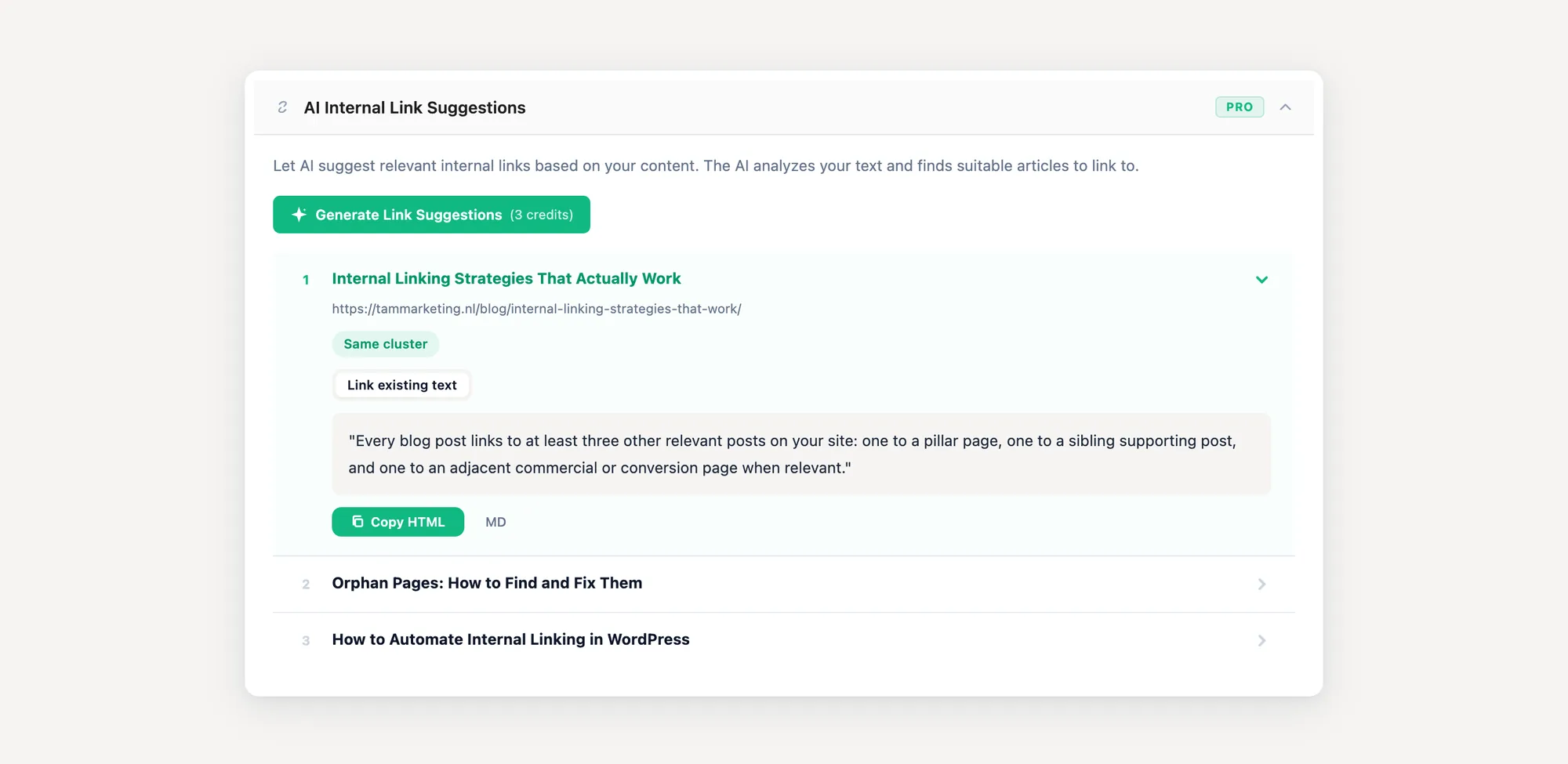
That keeps the useful part of automation, finding a suitable page at the right moment, without turning anchor text into a mechanical rule. See TamRank PRO’s reviewed internal-link suggestions.
What people ask
Does anchor text matter for internal links?
Yes, but as a context signal, not a ranking lever. Internal anchor text tells Google and your readers what the linked page is about. Google’s John Mueller has said optimising it beyond clear, descriptive wording produces no visible effect in search, so write anchors that accurately describe the destination and stop there.
What is the best anchor text for internal links?
A short, descriptive phrase that still makes sense when you read it without the surrounding sentence. Two to five words is a common rule of thumb. Avoid generic anchors like “click here”, and avoid pasting the identical keyword on every link. Describe the destination page honestly and let the wording vary naturally across posts.
Is exact-match anchor text bad for internal links?
Not in itself. One exact-match anchor that fits the sentence naturally is fine. Using exact-match keyword anchors on every internal link to a page is the mistake: it reads unnaturally, and in Zyppy’s 2024 data aggressive anchor engineering tracked with traffic losses. There is no penalty, but there is no benefit to overdoing it either.
Does the first link on a page count more?
There is no reliable evidence for it. First-link priority comes from a 2008 experiment Google never confirmed, and Mueller said in 2018 there is no fixed rule for how Google handles multiple links to the same page. Do not engineer link order. If an anchor matters, give the page one clean, standalone link.
Can over-optimised internal anchor text get my site penalised?
No. The Penguin algorithm targeted manipulative anchor text in backlinks from other sites, not your own internal links. There is no over-optimisation penalty for internal anchors. Over-stuffed internal anchors simply read badly and add no extra context, so fix them for clarity, not out of fear.
The bottom line
Internal anchor text sits in an awkward place: important enough to get right, not powerful enough to obsess over. Google has said twice, in 2020 and 2025, that optimising it produces no visible ranking change, and the measured evidence both supports descriptive anchors and warns against engineering them aggressively.
The whole practice then collapses into one habit. When you link to a page, describe that page in a few honest words, put the link in a sentence already about the topic, and write each link fresh instead of pasting a fixed keyword. Do that and the anchor is accurate, the variety happens on its own, and you never go near the folklore. Reviewing the anchors already scattered through your older posts is one step of a full internal linking audit, and it pairs naturally with the wider plan in the internal linking strategy guide and the complete internal linking guide.
Sources
- Google Search Central, “Links best practices,” including guidance on writing good link text. Google developer documentation.
- John Mueller (Google), on internal anchor text and “visible effect in search,” office-hours session, 2020. Reported by Search Engine Journal.
- John Mueller (Google), on anchor text overuse and link dilution, April 2025. Reported by Search Engine Journal.
- “First Link Priority: Is It A Google Ranking Factor?” Search Engine Journal.
- Cyrus Shepard (Zyppy), “23 Million Internal Links: SEO Case Study” (2023). zyppy.com/seo/seo-study.
- Cyrus Shepard (Zyppy), “How Recent Google Updates Punish Good SEO,” 50-site case study (2024). zyppy.com.
- SearchPilot, internal linking SEO split-test case studies, including an internal anchor text test. SearchPilot.

