Link equity, link juice, PageRank: three names circling one real idea, and the idea is usually explained wrong. The popular picture is plumbing. A page holds a tank of ranking power and pipes it down its links, and your job is to aim the pipes. That picture is wrong in ways that matter, because it leads to tactics that do nothing.
This is the honest version of how internal links pass authority. Where the fluid metaphor holds, where it breaks, what actually happens when one page links to another, and what that means for two questions people reliably get wrong: how many links a page should have, and whether you can steer where the equity goes. It is the technical core of internal linking, without the folklore.
- Link equity is a working name for PageRank, the link-based authority signal Google still uses. It is not a number Google shows you, and “link juice” is a metaphor John Mueller has said to ignore.
- A page passes authority through its links. In the original PageRank model that authority splits evenly across every outbound link; Google has since described a weighted model where a prominent link passes more than a buried one.
- Internal links redistribute the authority your site has already earned. External backlinks are what bring new authority in.
- There is no ideal number of links per page. Google dropped its old “100 links” guideline years ago. More outbound links means a thinner share each, but there is no penalty and no magic cap.
- You cannot sculpt equity with nofollow. That stopped working around 2008. You route equity by choosing what to link, not by blocking links.
What link equity actually is
Link equity is the authority a page can pass to other pages through its links. The mechanism underneath it is PageRank, the algorithm Larry Page and Sergey Brin published in 1998 while building Google. The idea is simple: a link from one page to another is a vote, and a vote from a page that is itself well linked counts for more than a vote from a page nobody links to.
PageRank is not a museum piece. Google retired the public Toolbar PageRank score in 2016, which is why many people assume the whole thing is gone, but the internal signal stayed. Gary Illyes of Google said plainly on Google’s own podcast in 2020, “we still use PageRank after all these years”. John Mueller has said the same, with one honest caveat: it is “not quite the same as the original paper”, and Google layers many other signals on top, some of them much stronger. So PageRank is real and current. It is one ingredient, not the whole recipe.
“Link juice” is the folk term for the same thing, and it is worth dropping. Mueller has said outright that anything talking about link juice should be ignored. The problem is not the concept, it is the plumbing metaphor: it makes equity sound like a fixed fluid that drains and refills in tidy amounts, and that picture leads to bad tactics. Use “link equity” as a mental model, hold it loosely, and remember Google does not expose an equity number you can read.
One distinction matters before anything else. Internal links and external links do different jobs. An external link, a backlink from another website, is how new authority enters your site. An internal link, between two pages you own, does not create authority. It moves authority you already have from one of your pages to another. Internal linking is distribution, not generation. The wider case for why that distribution is worth your attention is in why internal links matter more than you think; this article is about the mechanics of the distribution itself.
How equity flows between pages
Here is the mechanism, starting with the 1998 model. A page holds an amount of PageRank. It passes that PageRank outward through its links. The original formula normalised by the number of links on the page, so the authority split evenly: a page with PageRank to give and four outbound links passed roughly a quarter through each. Add a fifth link and each one carries a fifth instead. That arithmetic is the source of every “spread too thin” warning you have read.
There is a second piece, the damping factor, set at 0.85 in the paper. In plain terms, roughly 85% of a page’s PageRank flows onward through its links and the rest does not. The model imagines a “random surfer” clicking from link to link who, about 15% of the time, gets bored and jumps to an unrelated page. The damping factor is that boredom. For a practical purpose it means a little authority is lost at every hop, so a page five clicks from your homepage receives a fainter signal than a page one click away.
The even split is the part that has changed. Google’s later “reasonable surfer” model, described in a patent filed in 2004, replaces the random surfer with a more realistic one who does not click every link with equal probability. A prominent in-content link, high on the page and inside a sentence about the topic, is more likely to be clicked than a link buried in the footer, so the model lets it carry more authority. Treat this carefully: a patent shows what Google invented, not a guarantee of what runs today. The safe reading is modest. Do not assume your authority divides perfectly evenly across every link on a page. A link a real person would actually click is worth more than one they never would.
Put numbers on it, as a teaching example rather than a measurement. Say a page has the equivalent of 10 units of internal authority to pass on. With 5 outbound links, the even-split model sends 2 units down each. Add 15 more links, 20 in total, and each carries half a unit instead. Nothing was penalised; the same authority is simply divided 20 ways instead of 5. Then apply the weighted view. Of those 20 links, the 3 genuine in-content links to related articles almost certainly carry more than the 17 navigation and footer links, because a reader is far more likely to click them. The lesson is not “have fewer links”. It is that the links which carry your authority should be the ones a reader would actually follow.
How many internal links should a page have?
This is the question link equity is supposed to answer, and the honest answer is that there is no number. It is worth explaining why, because one specific figure has haunted SEO advice for fifteen years.
The figure is 100. Google’s old webmaster guidelines once advised keeping a page under roughly 100 links. That number was never about quality. Early Googlebot truncated pages at around 100 kilobytes, so content and links past that point might not be indexed, which worked out at about one link per kilobyte. It was a technical limit of how crawling worked, not a rule about good linking. Crawlers improved, the truncation went away, and Matt Cutts of Google confirmed in 2013 that the 100-links guideline had been dropped. Google’s current documentation puts it directly: “There’s no magical ideal number of links a given page should contain. However, if you think it’s too much, then it probably is.”
So the count is not a target, it is a consequence. You do not decide “this page gets eight internal links”. You decide which other pages genuinely deserve a link from this one, and the number is whatever that adds up to. The equity arithmetic still runs in the background, every extra link is one more way the page’s authority is split, but that is a reason to link deliberately, not a reason to chase or avoid a quota.
The real ceiling is not equity dilution, it is structure. Mueller put it well in 2021: if you add so many internal links that Google can no longer make out a structure, “that does make it harder for us to understand what you think is important”. A page that links to forty others, or a site where every page links to every other page, has flattened its own hierarchy. Nothing stands out, because everything is linked. The failure mode is not a penalty for too many links, it is the quiet loss of the very signal internal links exist to send.
Routing equity to the pages that matter
If internal linking is distribution, the practical job is routing: making sure the authority you already have reaches the pages you actually need to rank.
Start from where the authority is. The pages on your site with the most equity to pass on are usually your homepage and the pages other websites have linked to. Find those, then make sure each of them carries an in-content link towards a priority page. A backlink-rich blog post that links to nothing important is authority sitting idle. The internal linking strategy guide covers how to identify those authority pages in Search Console; the point here is that routing starts with them.
Favour in-content links over boilerplate. A link inside the body of a relevant article is the strong kind: a reader might genuinely click it, and on the weighted model that is what carries authority. The same target linked only from a sitewide footer or a mega-menu still counts, but Google treats template links as navigational and weights them down. This is not a reason to strip your navigation, it is a reason not to mistake a footer link for real routing.
Keep priority pages shallow. Because a little authority fades at every hop, a page reachable in two clicks from the homepage receives more than the same page buried six clicks deep. Pulling important pages closer to the homepage is one of the highest-impact routing moves available, and it is also why a page with no inbound internal links at all, an orphan page, receives nothing to route in the first place.
Then the myth worth retiring: you cannot sculpt equity with nofollow. PageRank sculpting was the practice of putting rel="nofollow" on internal links you considered less important, hoping to channel more authority into the rest. It has not worked since around 2008. Matt Cutts disclosed the change in 2009: a nofollowed link still uses up its share of the page’s PageRank, the share is simply not passed on, and it is not handed to your other links either. Nofollowing your “About” link does not give your product page a bigger slice, it just wastes the slice. Nofollow has since become a “hint” rather than a strict directive, Google changed that in 2019 and 2020 alongside the rel="sponsored" and rel="ugc" attributes, but none of that revived sculpting. You route equity by choosing what to link and how prominently, not by blocking links.
How TamRank helps
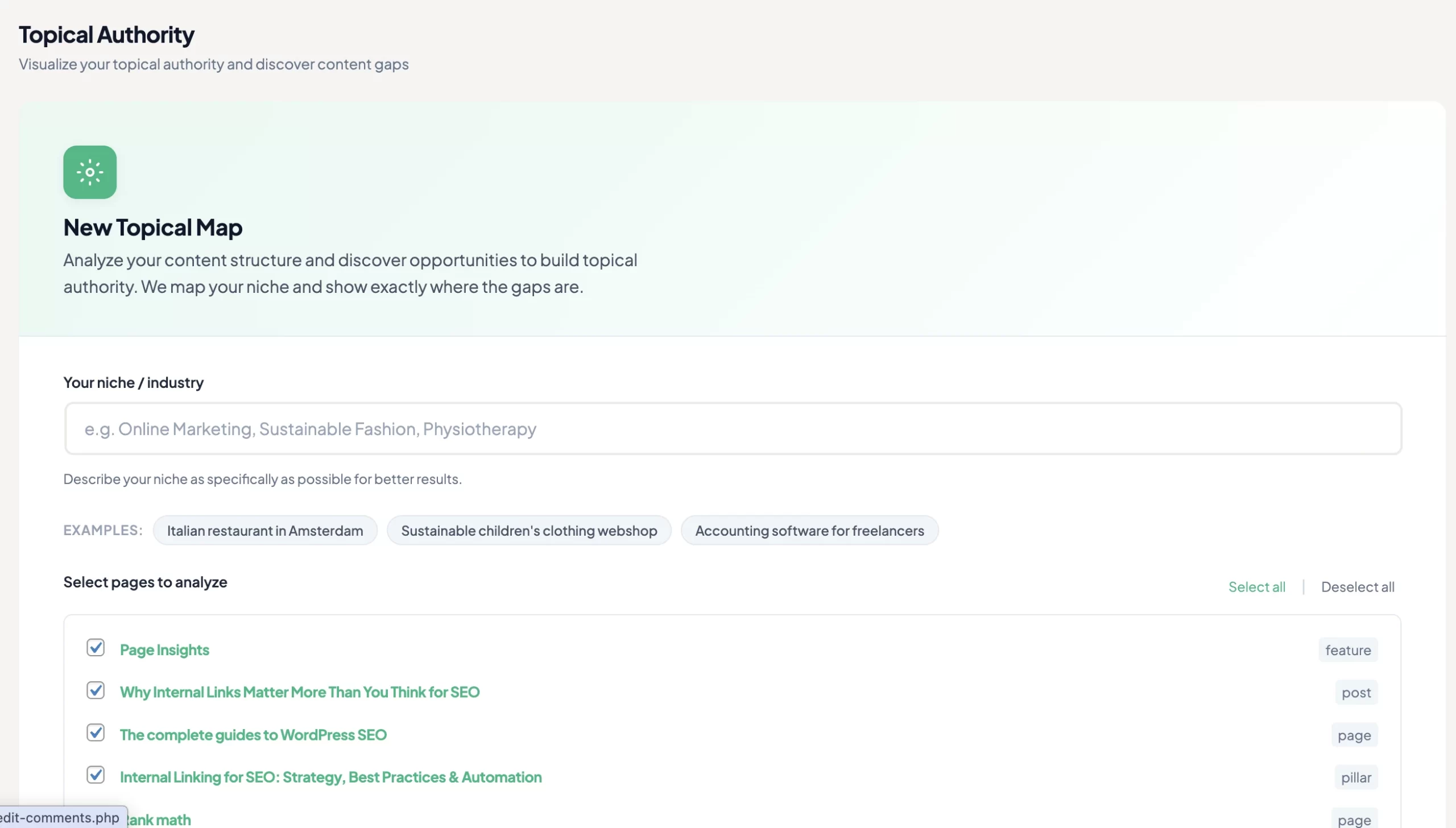
TamRank Free maps contextual internal links and shows which published pages receive few or no incoming links. That makes the structure visible, but it does not calculate an exact PageRank value or pretend that every missing link has the same impact.
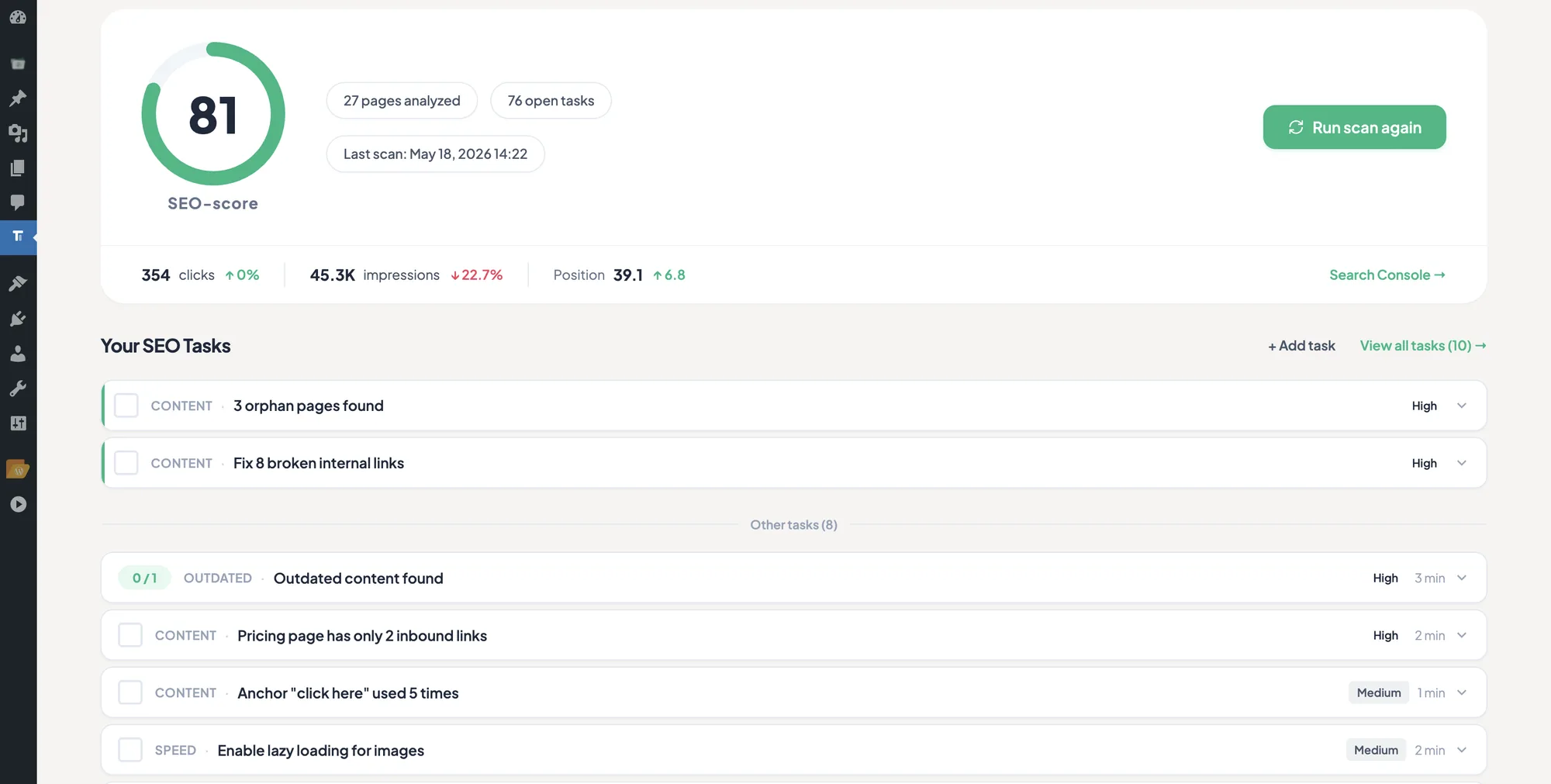
TamRank PRO adds the context needed to decide where attention is justified. It combines the link finding with Search Console reach, page importance, confidence and likely effort. An important page that already has search demand can therefore rise above a low-value URL with fewer links.
AI Internal Link Suggestions can then help find a relevant source page and suitable anchor text. You still decide whether the link improves the page for a reader. Start with the free link graph, or see how PRO prioritises internal-link work.
What people ask
What is link equity in SEO?
Link equity is the authority a page passes to other pages through its links. It is a practical name for PageRank, the link-based signal Google still uses. Google does not publish an equity score, so treat it as a mental model: links from authoritative pages help the pages they point to, both internally and from other sites.
Do internal links pass PageRank?
Yes. An internal link passes a share of the linking page’s PageRank to the page it points to. It does not create new authority, it redistributes authority your site has already earned. External backlinks bring new PageRank into a site; internal links decide where that authority then goes.
How many internal links should a page have?
There is no ideal number. Google dropped its old guideline of roughly 100 links per page years ago, and its current documentation says there is “no magical ideal number”. More outbound links means each passes a thinner share, so link deliberately, but treat the count as the result of good decisions rather than a target to hit.
Can you use nofollow to control where link equity goes?
No. PageRank sculpting with nofollow stopped working around 2008. A nofollowed internal link still uses up its share of the page’s authority, and that share is not passed to your other links, it is simply lost. You route equity by choosing what to link and how prominently, not by nofollowing internal links.
Does Google still use PageRank?
Yes, as an internal signal. Google retired the public Toolbar PageRank score in 2016, but Google staff have confirmed since then that PageRank is still in use. It is no longer the 1998 algorithm on its own, it is one signal among many, but link-based authority still counts.
The bottom line
Link equity is a real thing wearing a misleading name. Underneath “link juice” is PageRank: still used, still link-based, but layered with many other signals and no longer a tidy fluid. A page passes authority through its links, internal links move the authority your site has earned, and external links bring new authority in.
Two practical conclusions fall out of that. The number of links on a page is not a dial to set, it is the result of linking deliberately to the pages that deserve it. And you cannot game where authority flows with nofollow or clever link order, you route it by choosing what to link, keeping priority pages shallow, and favouring the in-content links a reader would actually click. The complete internal linking guide sets the framework, and a full internal linking audit turns this into a routing process you can repeat.
Sources
- Sergey Brin and Lawrence Page, “The Anatomy of a Large-Scale Hypertextual Web Search Engine,” Stanford, 1998, the original PageRank model and damping factor. infolab.stanford.edu.
- Google, “reasonable surfer” patent US7716225B1, “Ranking documents based on user behavior and/or feature data” (filed 2004, granted 2010). patents.google.com.
- Gary Illyes (Google), “we still use PageRank,” Search Off the Record podcast, 2020. Reported by Search Engine Journal.
- John Mueller (Google) on the term “link juice,” 2022. Reported by Search Engine Journal.
- Matt Cutts, “PageRank sculpting” (2009). mattcutts.com.
- Google Search Central, “Evolving ‘nofollow’, new ways to identify the nature of links” (2019). Google developer blog.
- Google Search Central, “Links best practices,” including “no magical ideal number” of links. Google developer documentation.
- “Google’s Matt Cutts: We Dropped The 100 Links Per Page Guideline” (2013). Search Engine Land.
- John Mueller (Google) on diluting site structure with too many internal links, 2021. Reported by Search Engine Journal.

