Almost everything written about internal linking is asserted, not measured. Google says links help. SEO guides repeat it. The advice sounds reasonable, so it gets passed along, and a reasonable-sounding claim is not the same thing as evidence.
A small number of people actually tested it. SearchPilot ran controlled split tests on live sites. Zyppy analysed 23 million internal links against real Google traffic. Their results make a stronger case for internal linking than any best-practice list, and they also contain a few inconvenient findings that most articles quietly skip. This is the honest version of the case, built on what was measured.
- Internal linking is one of the few SEO levers with controlled-experiment evidence behind it, not just opinion.
- SearchPilot’s split tests have measured real organic traffic gains from internal linking changes, including a 25% lift on one retailer. Their own data shows the win usually comes from better crawl paths and page structure, not from raw link count.
- Zyppy’s analysis of 23 million links found inbound internal links correlate with more Google clicks up to a ceiling around 40 to 50 per page, and that anchor text variety mattered even more than link count.
- The honest limit: internal linking is a multiplier on content that can already compete. It will not rank weak content, and for most sites crawl budget is not a real constraint.
- Most sites badly under-link their own pages: 53% of the URLs in Zyppy’s data had three or fewer inbound internal links. That gap is the opportunity.
What internal links actually do
An internal link is a clickable connection from one page on your site to another page on the same domain. Google’s crawler uses them for three jobs: discovering pages, working out which pages you treat as important, and reading the anchor text and surrounding words to understand what the linked page is about.
John Mueller called internal linking “one of the biggest things you can do on a website” in a 2022 Google office-hours session, with one condition that often gets missed: it has to be a real HTML link. A connection built only in JavaScript, or implied through structured data, does not carry the same weight. If a link matters, it should be a plain <a href> a crawler can follow without running scripts.
That is the whole mechanism, simple enough to explain in a paragraph, which is part of why teams underrate it. The interesting question is not how internal links work but how much they move. The complete internal linking guide covers the mechanics; this article is the case for why they earn your attention.
The evidence that internal linking moves rankings
Most proof that internal linking works is circular: Google says it matters, so guides say it matters. SearchPilot is the exception. They run controlled SEO split tests. Comparable pages are divided into a control group and a variant group, the change is applied only to the variant, and real organic traffic is compared against a forecast. It is close to a genuine A/B test for SEO, which almost nothing else in the field offers.
Their internal linking results are consistently positive. Adding links from the homepage footer to deeper pages produced about a 5% traffic gain on the destination pages. Adding links between geographically related pages, across roughly 8.000 regional pages, produced about 7% on the receiving pages. Their most cited test, on the retailer Iceland, added links from mid-level category pages down to sub-categories that had previously been reachable only through the main navigation. Organic traffic rose about 25%.
Here is the part most articles drop. SearchPilot is explicit that the Iceland result does not mean “add more links”. The win came from making pages reachable, from giving the crawler and the reader a real path to content that was previously buried. It was an information architecture fix that happened to be delivered through links.
And one of their tests cuts against the simple story entirely. When SearchPilot increased the number of related-article links on a content hub, the pages that received those new links showed no measurable traffic change. The pages that gave the links rose about 16%. The likely reason is partly statistical, the recipient pages had too little traffic to detect a small effect, but the takeaway still stands: internal linking is not a clean pipe that pumps ranking power into whatever you point it at. A large part of its value sits in the page doing the linking, and in whether a path to important content exists at all.
What 23 million internal links reveal
SearchPilot shows internal linking causes traffic changes on the sites they tested. Zyppy’s study shows the shape of the relationship at scale. Cyrus Shepard analysed 23 million internal links across roughly 1.800 websites, matching the inbound internal link count of each URL against its Google Search Console click data.
The headline pattern: pages with more inbound internal links tended to get more Google clicks. Pages with only 0 to 4 inbound internal links averaged around 2 clicks. Pages in the 40-plus range averaged several times that. But the curve is not a straight line. The steep gains happen early, roughly across the first 10 inbound links. Between 10 and 30 the line flattens and wobbles. Past about 40 to 50 inbound links, traffic starts to fall.
Two things are easy to misread. First, this is correlation, and Shepard says so plainly: the findings are directionally useful, not scientific truth. The decline past 45 links is most likely a clue about link type, not a penalty for link quantity. A page sitting on 80 inbound internal links usually collected them from sitewide navigation or footers, and Google discounts boilerplate links that appear on every page. The lesson is not “never exceed 45 links”, it is that an editorial in-content link is worth more than a chrome link.
Second, and most useful, the strongest signal in Zyppy’s data was not link count at all. It was anchor text variety. Pages linked with a wide range of natural anchor phrases outperformed pages linked repeatedly with the same phrase, and Shepard reported re-running that analysis three times because the relationship was so clean. One caveat keeps it honest: some 2024 analyses of sites that lost traffic claim the opposite, that anchor variety can track with declines. Both are correlational and they disagree, so treat anchor variety as a strong signal, not a settled law. The safe reading is the boring one: link with the words a human would naturally use, and the variety takes care of itself.
The single most actionable pattern in the study is how thin most internal linking is. 53% of the URLs Zyppy analysed had three or fewer inbound internal links, and only about a quarter had more than ten. A separate study by InLinks, across 5.112 sites and counting only in-content links rather than menus or sidebars, came at the same gap from the other side: it found that 82% of internal link opportunities, places where a page discusses a topic without linking to the page that covers it, were going unused. Two studies, two methods, one conclusion: most sites do not need more content to benefit from internal linking, they need to connect what they already have. The cause is almost always neglect, a post gets one link down from a category page and is then never revisited or wired to the rest of the site.
What internal linking does not do
An honest case has to include the limits, because overselling internal linking is how teams end up disappointed.
Internal linking is a multiplier, not a foundation. It redistributes the authority and relevance your site has already earned. It cannot manufacture authority that was never there. A genuinely weak page, thin content, no demand, no real expertise, will not rank because you pointed ten internal links at it. SearchPilot’s recipient-page result is the warning sign: links into a page are not a substitute for the page being worth ranking on its own.
Internal anchor text is not the lever older SEO advice claimed. In a 2020 office-hours session, Mueller said the effect of anchor text on internal links specifically is “not something where you would see a visible effect in search”. It still helps Google understand what a page is about. It is not a keyword dial to crank.
Crawl budget is mostly a non-issue. Google’s own documentation states the crawl budget guidance is meant for very large sites, in the range of a million or more pages, or large sites with rapidly changing content. If you run a 200-post blog, Google is not failing to crawl you for budget reasons, and internal linking will not rescue a crawl problem you do not have. The genuine discovery problem at smaller scale is narrower and worse: orphan pages, pages with zero inbound internal links, which Google may struggle to find at all.
And some popular internal-linking claims are simply weak. The idea that a nofollow attribute lets you sculpt where internal authority flows has been false since Google changed that behaviour around 2008: the withheld authority evaporates, it does not get redirected to your other links. Treat any internal-linking tactic that sounds like a clever loophole with suspicion. The mechanism is not complicated enough to have loopholes.
Why the payoff compounds, and why teams under-invest
If internal linking is this well evidenced, why do most sites still leave so much of it undone? The answer is the feedback loop, or rather the absence of one.
Add an internal link today. Google recrawls the page over the next one to three weeks. It recalculates how important the linked page is over the weeks after that. If a ranking change comes, it arrives slowly and quietly, mixed in with every other thing that changed on your site and across the web in that window. Almost nobody can point at a single link and say that one did it.
Compare that to publishing a new post, which feels like progress the moment you hit publish, or buying a backlink, which shows up in a tool the next day. Internal linking has no dopamine. The work is repetitive, the payoff is deferred and hard to attribute, so it loses nearly every prioritisation argument it is in.
That is also why it stays an edge. The teams that keep doing it anyway, a few deliberate links every week, build a denser, better-connected site than competitors who only chase visible wins. The compounding is real precisely because the work is boring, and almost nobody sustains it.
Internal links and AI search
AI search does not change the case, it extends it. Tools like Google’s AI Overviews, ChatGPT search and Perplexity still lean heavily on pages that already rank well in classic Google results. Ahrefs’ analysis of AI Overview citations found that a large share of cited pages were already ranking on the first page for the query. Whatever helps classic rankings, internal linking included, also helps the odds of being cited.
There is a second, structural reason. AI answers are assembled from passages, chunks of a page retrieved and recombined, and a page an AI system cannot discover and crawl cannot be retrieved from at all. Internal links are the main way pages get discovered. Be sceptical of the specifics, though: no solid study proves internal links cause more AI citations, and any blog quoting a precise uplift percentage is almost certainly repeating a vendor figure with no methodology behind it. The honest statement is the modest one: internal linking keeps your pages discoverable and well ranked, and that is what AI search rewards.
How TamRank helps
Internal links need two different checks. First you need a reliable view of what exists. TamRank Free runs inside WordPress, maps the contextual links between your published pages and shows orphaned or weakly connected content. It also helps catch broken or missing links while you work.
That inventory does not automatically tell you what deserves attention first. TamRank PRO adds the decision layer. It combines the link problem with evidence such as Search Console reach, movement, page importance and confidence. A forgotten page with no value can remain an observation, while an important page that is being starved of internal links becomes an action.
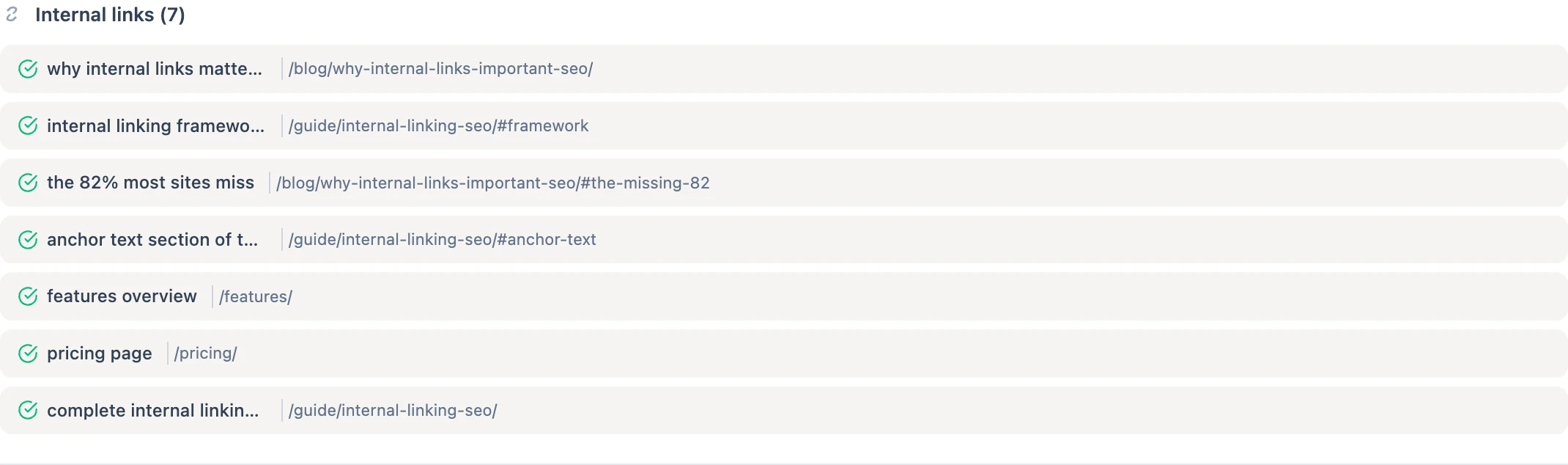
When a relevant link opportunity exists, PRO can suggest a target and suitable anchor text inside the editor. You review the suggestion before using it. Start with the free link checks, or see how PRO turns the findings into a controlled work queue.
What people ask
Are internal links actually a Google ranking factor?
Not a direct one, and it is more honest to say so. Internal links shape three things that feed rankings: which pages Google discovers, which pages it reads as important, and what topic it associates with each page. Controlled split tests from SearchPilot have measured real organic traffic gains from internal linking changes, so the effect is genuine even though “ranking factor” is the wrong label for it.
How long before internal linking changes show up?
Crawl and indexation changes appear within one to three weeks. Ranking movement, if it comes, follows over the weeks after that as Google recalculates page importance. Smaller sites tend to see it sooner because their recrawl cycle is shorter. The slow, hard-to-attribute feedback loop is the main reason internal linking gets neglected.
Do internal links pass “link equity”?
Yes, with two caveats. They redistribute authority your site has already earned, they do not create new authority. And the share each link passes is diluted by how many links sit on the page, with sitewide navigation and footer links discounted because they appear everywhere. Internal links move the trust you have around; external links are what grow it.
Can a page have too many internal links?
Zyppy’s data shows traffic rising with inbound internal links up to roughly 40 to 50 per page, then declining. The decline is most likely a sign of link type, not a quantity penalty: heavily linked pages tend to collect boilerplate navigation links, which carry little weight. Focus on editorial in-content links and the count rarely becomes the problem.
Do internal links still matter with AI search?
Yes, indirectly. AI Overviews and tools like ChatGPT and Perplexity cite heavily from pages that already rank well in classic Google results, and they can only retrieve from pages they can discover and crawl. Internal linking supports both. Be sceptical of any article claiming a precise AI-traffic uplift from internal links; that evidence does not exist yet.
The bottom line
Internal linking is one of the few SEO levers you can defend with measurement rather than belief. SearchPilot’s controlled tests show it moves real traffic. Zyppy’s 23 million links show the shape of the relationship and how thinly most sites link their own pages. The honest limits matter just as much: it is a multiplier on content that can already compete, not a rescue for content that cannot.
What stops most teams is the feedback loop, not the work. A few deliberate internal links every week, sustained for a year, builds a tighter site than a backlink budget several times the size. The complete internal linking guide covers the framework and the audit steps. Start there, then keep going when it stops feeling like progress, because that is the point where most of your competitors quit.
Sources
- SearchPilot, internal linking SEO split-test case studies, including the Iceland internal linking test (2020) and related-article, nearby-location and homepage-footer tests. SearchPilot case studies.
- Cyrus Shepard (Zyppy), “23 Million Internal Links: SEO Case Study” (2023). zyppy.com/seo/seo-study.
- InLinks, “82% of Internal Linking Opportunities Missed,” case study of 5,112 websites (2022). inlinks.com.
- John Mueller (Google), “internal linking is super critical for SEO,” Google SEO office hours, 2022. Reported by Search Engine Journal.
- John Mueller (Google), on internal anchor text and “visible effect in search,” Webmaster Central hangout, 2020. Reported by Search Engine Journal.
- Matt Cutts, “PageRank sculpting” (2009). mattcutts.com.
- Google Search Central, “Managing crawl budget for large sites.” Google developer documentation.
- Ahrefs, analysis of AI Overview citations and their overlap with top-10 rankings. Ahrefs blog.

