You can do everything else right and still not rank. The keyword has volume, the article is thorough, the structure is clean, the page loads fast. And it sits on page three, because it answered a question the searcher was not asking. That is a search intent failure, and it is the one SEO mistake that no amount of polishing the page will fix.
Search intent is the goal behind a query, and matching it is a decision you make before you write a word. The topical authority pillar makes the point that every article in a cluster targets a query, and an article aimed at the wrong intent fails regardless of how good the cluster around it is. This guide is the practical half: what the intent types are, how to read the intent of a query from the evidence Google gives you, and how to match content to it.
- Search intent is the goal behind a search, not the words in it. The concept comes from Andrei Broder’s 2002 paper, which showed that web search is often not about finding information at all.
- There are four working types: informational, navigational, commercial and transactional. Each is best served by a different kind of page.
- You identify intent by reading the live SERP, not by guessing from the keyword. The pages and features Google already ranks are its published answer to what the query wants.
- Content type follows intent. An informational query needs a guide; a transactional query needs a product or signup page. The format follows too.
- Intent mismatch, targeting a query with the wrong page type, is a failure no amount of on-page polish corrects. The fix is to re-match or re-target.
What is search intent?
Search intent is the goal a person is trying to reach when they type a query: the reason behind the words, not the words themselves. Two people can search the same three words and want completely different things, and the job of a page that wants to rank is to serve the goal, not to match the string.
The idea is older and better founded than most SEO writing admits. In 2002, Andrei Broder, then at AltaVista, published “A Taxonomy of Web Search” and made a point that reshaped the field. Classic information retrieval had always assumed a searcher was driven by an “information need”. Broder showed that on the web this is often false: the need behind a query “might be navigational” or “transactional” instead, and “informational queries constitute less than 50% of web searches”. Search intent, in other words, is not a marketing idea bolted onto SEO. It is the foundational observation that not all searches want the same kind of result.
What are the four types of search intent?
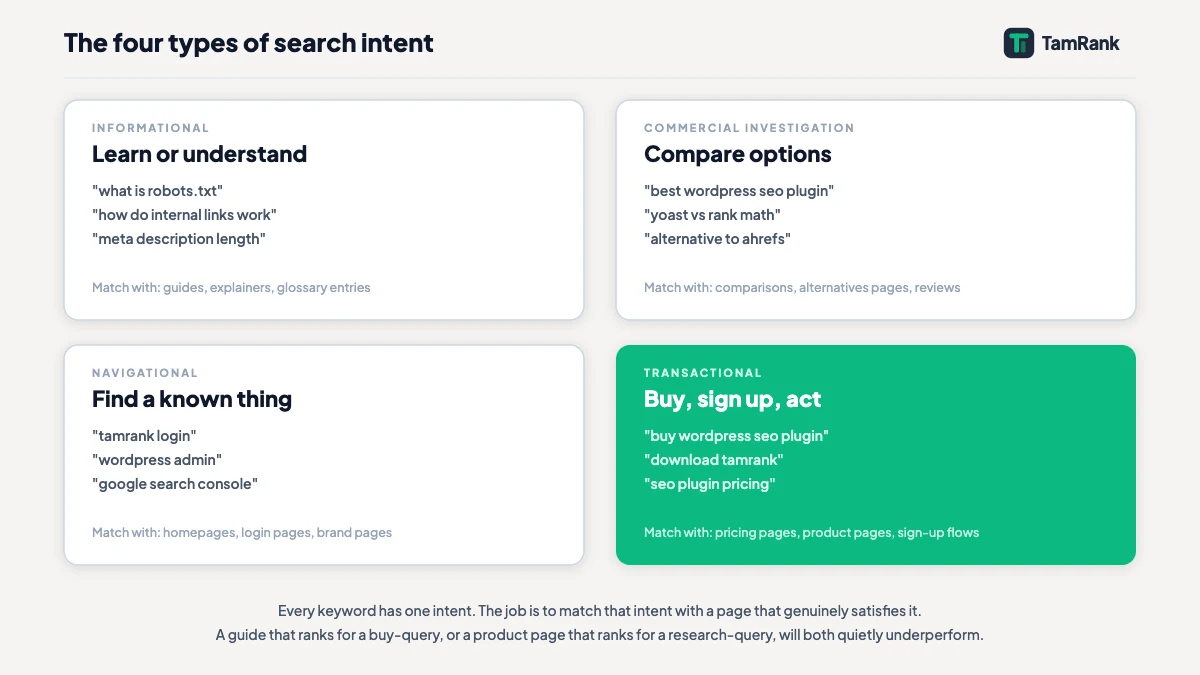
Broder defined three intent classes. Modern SEO works with four, splitting his categories slightly to separate the act of researching a purchase from the act of making it. The four are informational, navigational, commercial and transactional.
| Intent | What the searcher wants | Example query | Page that wins |
|---|---|---|---|
| Informational | To learn or understand something | what is search intent | A guide or explainer |
| Navigational | To reach a specific site or page | tamrank login | That exact page |
| Commercial | To research before a purchase | best wordpress seo plugin | A comparison or review |
| Transactional | To do something, usually buy | buy yoast premium | A product or signup page |
Informational is Broder’s original informational class: the searcher wants to acquire knowledge assumed to be on a web page. This is the largest group and the one most blog content targets.
Navigational is Broder’s navigational class: the searcher already has a destination in mind and is using search to get there. You do not write content to win a navigational query for someone else’s brand, and you do not need much content to win your own.
Commercial, sometimes called commercial investigation, is the type Broder did not separate out and the SEO industry added. The searcher intends to buy, but not yet. They are comparing, reading reviews, narrowing a shortlist. Queries with “best”, “top”, “review” or “X vs Y” are usually commercial.
Transactional is Broder’s transactional class: the intent is to perform an action, most often a purchase or a signup. The searcher has decided and wants to do, not read.
Google’s own systems use a parallel scheme. Its Search Quality Rater Guidelines ask human raters to classify a query as Know, Do, Website or Visit-in-person, which maps closely onto informational, transactional, navigational and a fourth, local intent. The exact labels matter less than the shared principle: a query has a goal, and a result either serves that goal or does not.
How do you identify the search intent of a keyword?
Here is the mistake to avoid: deciding a query’s intent by reading the keyword. The words are a weak signal. “Mechanical keyboard” could be someone wanting to learn what one is, someone comparing models, or someone ready to buy. The query alone does not tell you, and Broder said as much in 2002: there is no assumption that intent “can be inferred with any certitude from the query”.
The reliable method is to read the live SERP. Google has already decided what each query wants and published that decision as the top ten results. Search the query, look at what ranks, and you are reading Google’s own answer. Three things to look at:
- The page types ranking. Are the top results how-to guides and explainers, or product and category pages, or comparison listicles, or brand homepages? Whatever dominates the top five is the format Google has judged this query wants. If the first page is all “best of” listicles, the intent is commercial, and a single-product page will not break in.
- The SERP features. A featured snippet or “People also ask” box signals informational intent. Shopping ads and product listings signal transactional. A local map pack signals visit-in-person intent. These features are Google telling you the dominant intent out loud.
- The query modifiers, as a secondary check. “How”, “what”, “why”, “guide” lean informational. “Best”, “top”, “review”, “vs” lean commercial. “Buy”, “price”, “discount”, “for sale” lean transactional. A brand name leans navigational. Useful as a first guess, but the SERP overrules the modifier every time they disagree.
One worked example. The query “wordpress seo plugin” looks informational, a person learning about a category. Read the SERP and the top results are almost all comparison listicles, “best WordPress SEO plugins”, with product and review pages mixed in. Google has classified this query as commercial. If you write a neutral explainer of what a WordPress SEO plugin is, you have written for an intent the SERP says this query does not have, and you will not rank. The SERP corrected the guess the keyword invited.
One thing the SERP does not announce is that it changes. Google re-reads intent over time, so a query that was informational two years ago can show a page of product results today, usually because commercial demand built up around it. This is worth knowing when you refresh an older article: a ranking slide is sometimes not the content decaying at all, but the query’s intent moving out from under a page that was matched correctly when it was written. Re-checking the SERP is part of any refresh.
How do you match content to search intent?
Once the SERP has told you the intent, the content type is mostly decided for you. Matching means picking the format Google has already shown wins, then doing it better than the pages doing it now.
- Informational intent wants a guide, an explainer or a tutorial. The page teaches. The job is depth and clarity, and the call to action is soft, a next step to read, not a checkout.
- Commercial intent wants a comparison, a review or a considered “best” list. The page helps a decision. It needs honest evaluation, real criteria and a clear recommendation, not a disguised advert for one option.
- Transactional intent wants a product, pricing or signup page. The searcher has decided. A long explainer here is friction; the page should let them act.
- Navigational intent wants one specific page to exist and be findable. For your own brand, make sure that page is clean and indexable. For another brand’s navigational query, leave it alone.
Intent also sets the format, not just the type. An informational query answered well tends to be longer, structured for scanning, and patient. A transactional page is short, direct and built around one action. Reading intent and then writing the wrong length for it is a quieter version of the same mismatch. Google’s guidance on helpful content frames the test plainly: a reader should finish feeling they have learned enough, or done enough, to achieve the goal they arrived with. That goal is the intent. The page either delivers it or it does not.
Intent mismatch: the failure that on-page work cannot fix
Intent mismatch is targeting a query with the wrong type of page. It is worth naming as its own failure mode because it is invisible to every normal SEO check. The page can have a perfect title, clean structure, fast load and genuine depth, and still not rank, because none of those things is the problem.
The reason it cannot be fixed on the page is that the SERP is settled. When Google has filled the first page of a query with comparison listicles, it has decided that query is commercial, and a lone explainer is not competing badly, it is not competing at all. It is the wrong kind of thing. Adding words, links or speed does not change its kind.
So the fix is never on-page polish. It is one of two structural moves. Either re-match: rebuild the page as the type the SERP rewards, turning the explainer into the comparison the query actually wants. Or re-target: keep the page as it is and point it at a different query whose intent genuinely matches it, which is often a longer, more specific variant. The deeper guide to finding those is our guide to long-tail keywords, where intent tends to be sharper and easier to satisfy cleanly.
One honest complication. Some queries have genuinely mixed intent, and Google shows a split SERP: a few guides, a few product pages, a comparison or two. There the SERP is telling you it is not sure, and you have a real choice of which intent to serve. Most queries are not like this. When the top five results all share one format, the intent is settled, and arguing with it is the mismatch.
Search intent and topical authority
Search intent is where a topical cluster meets the individual page. The pillar plans the coverage and the topical map records, for every planned article, the intent of the query it targets. That field is not bookkeeping. It decides what each article has to be.
A healthy cluster spans intents on purpose. The informational spokes teach the subject and pull the top-of-funnel traffic. The commercial pages, the comparisons and reviews, catch readers closer to a decision. The pillar itself usually serves a broad informational intent. A content cluster built entirely of informational articles covers the subject but never meets the reader who is ready to act, and a cluster of nothing but commercial pages has no way to earn trust first. Coverage means covering the intents, not just the subtopics.
This is also why intent and topical authority reinforce each other. Every article that matches its intent cleanly is a page that can rank and can be cited by the others. Every article that misreads its intent is a weak link in the cluster, the kind of thin, underperforming page that, as the pillar notes, drags the whole cluster down.
How TamRank helps
Reading intent is judgement. It means looking at a real SERP and deciding what Google has concluded, and no plugin does that thinking for you. What a tool can do is show you, after publishing, whether your judgement was right.
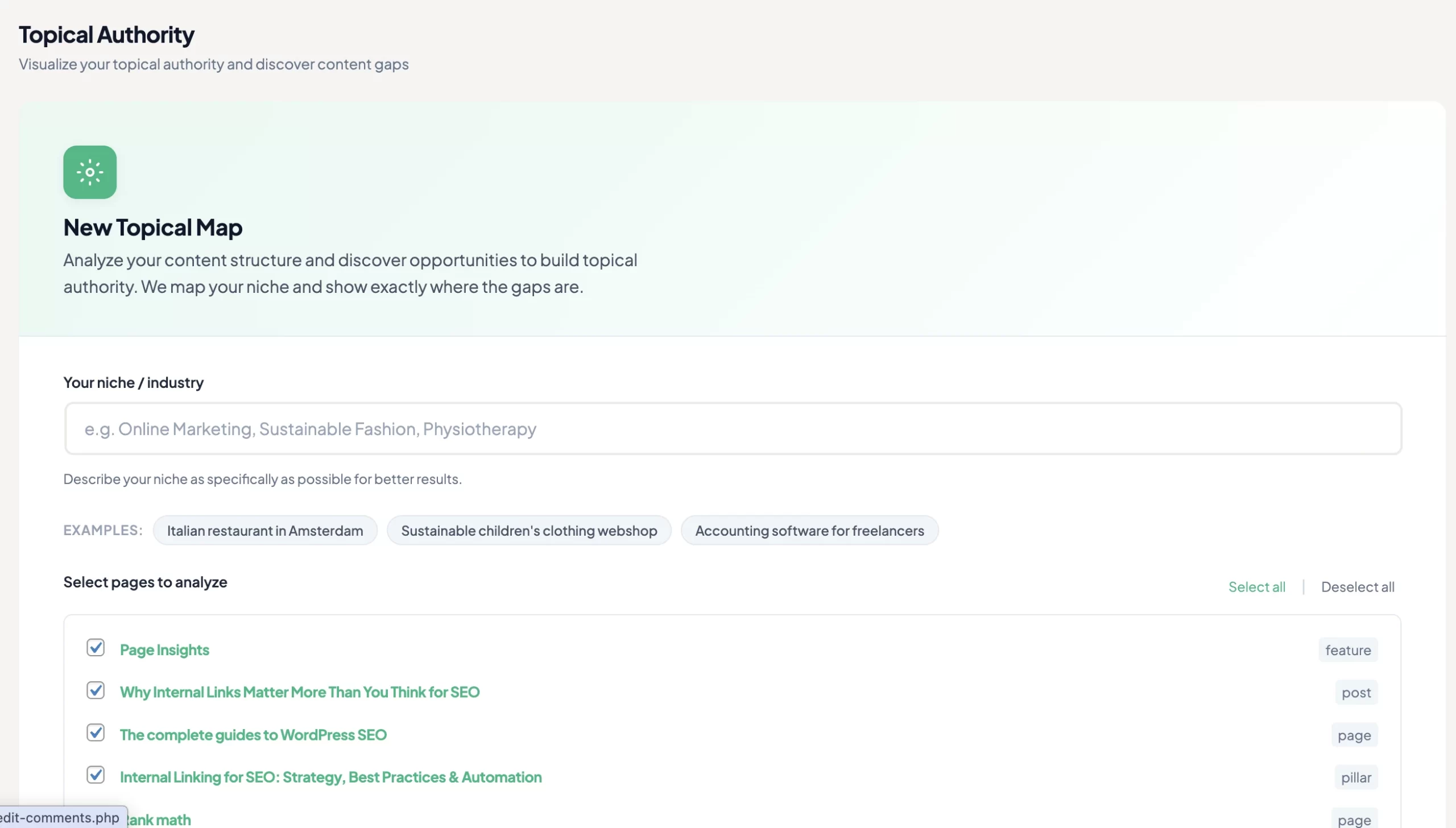
TamRank’s PRO Page Insights pulls the queries each page actually receives impressions and clicks for from Google Search Console. That data is the reality check on intent: if you built a page for an informational query and the impressions are arriving on commercial, “best of” variants, Google is telling you the page is being read as a different intent than you designed it for. Seeing that early is the difference between re-matching one page and discovering a whole cluster aimed slightly wrong.
It will not pick the intent for you, and it does not pretend intent is a number. It shows you where your content and the real query data disagree. You can see how it fits in the features overview or compare the free and PRO plans.
Search intent FAQ
What is search intent?
Search intent is the goal behind a search query: the reason a person is searching, not the words they typed. The concept comes from Andrei Broder’s 2002 paper “A Taxonomy of Web Search”, which showed that web searches are often not about finding information at all.
What are the four types of search intent?
Informational (wanting to learn something), navigational (wanting to reach a specific site), commercial (researching before a purchase) and transactional (wanting to do something, usually buy). Broder’s original taxonomy defined three; the SEO industry added commercial intent as a fourth.
How do you identify the search intent of a keyword?
Search the query and read the live SERP. The page types that rank, guides, product pages or comparisons, and the SERP features, such as featured snippets or shopping results, are Google’s published answer to what the query wants. Query modifiers like “best” or “buy” are a useful first guess but the SERP overrules them.
What is intent mismatch?
Intent mismatch is targeting a query with the wrong type of page, for example aiming an explainer at a query whose SERP is full of comparison listicles. It is a failure no amount of on-page optimisation fixes, because the page is the wrong kind of result. The fix is to rebuild the page or re-target it.
Why is search intent important in SEO?
Because matching intent is a precondition for ranking, not an optimisation on top of it. Google fills a SERP with the result type it has decided the query wants. A page of a different type does not rank poorly, it does not compete, regardless of how good its content is.
The bottom line
Search intent is the goal behind a query, and matching it is the decision that most determines whether a page can rank, made before the writing starts. It is not a new SEO trend. It is the observation, made by Andrei Broder in 2002 and built into how Google’s own raters assess results, that not every search wants the same kind of answer.
The method is steady. Identify the intent by reading the SERP, because the results Google already ranks are its decision about what the query wants. Match the content type to that intent, and the format with it. And treat intent mismatch as the structural failure it is, fixable only by rebuilding or re-targeting the page, never by polishing it.
For a topical cluster, intent is the field that turns a list of subtopics into a real plan, one that meets readers who want to learn and readers who are ready to act. If you want to check whether the pages you have built are drawing the queries you designed them for, TamRank’s Page Insights shows you the real query data behind each one.
Sources
- Andrei Broder, “A Taxonomy of Web Search,” ACM SIGIR Forum, Vol. 36, Issue 2, September 2002, on the three query classes and the finding that informational queries are under half of web searches. sigir.org.
- Google, “Search Quality Rater Guidelines” (PDF, last updated 11 September 2025), on the Know, Do, Website and Visit-in-person query classification. guidelines.raterhub.com.
- Google Search Central, “Creating helpful, reliable, people-first content,” on whether content lets a reader achieve the goal they arrived with. Google developer documentation.

