A content audit gets confused with its spreadsheet. You export every URL, add columns for clicks and word count and publish date, and the filled-in grid feels like the deliverable. It is not. The grid is the raw material. The audit is the decision you reach about each page once you have it, and a spreadsheet with no decisions in it is just an inventory.
This is the audit as a decision process: a method that takes every page you have published and ends with one of four verdicts on each, keep, update, merge or remove. It is scoped for one purpose, topical coverage. The topical authority pillar names the content audit as the inventory step of the maintenance loop and leaves the method here. This is that method.
- A content audit is a page-by-page review of everything you have published that ends in a decision for each page, not a spreadsheet of metrics.
- It matters for topical authority because the helpful content signal is site-wide: a high proportion of weak pages can hold back your strong ones.
- Score each page on five things: search performance, quality, accuracy, intent match, and its role in your topical coverage.
- Every page gets one of four verdicts: keep, update, merge or remove. Update is usually the most common and the highest return.
- Removing content is not a magic recovery lever. Improve what can be improved; remove only what has no path to being useful.
What is a content audit?
A content audit is a structured, page-by-page review of everything a site has published, carried out to decide what to do with each page. It looks at the content itself, whether each page is good, accurate and pulling its weight, and ends with a verdict on every URL.
It helps to separate it from two audits it gets confused with. A technical SEO audit looks at crawling, indexing and site health, the machinery rather than the writing. An internal linking audit looks at the link graph, how pages connect. A content audit looks at the pages as content: is this article any good, does it still hold up, and does it earn its place. The three are complementary, and this guide is only the third. When the subject is topical authority, the content audit is the one that matters most, because topical authority is made of content.
Why does a content audit matter for topical authority?
The obvious answer is to find pages that need fixing. The real answer, for a site building topical authority, is more pointed: your weak pages are a tax on your strong ones.
This is not a stylistic claim, it is how Google’s helpful content assessment works. The signal is site-wide. Google’s guidance on the August 2022 helpful content update is direct about it: a site carrying a relatively high proportion of unhelpful content can see that hold back the performance of its genuinely helpful content too. In the March 2024 core update that assessment was folded into core ranking, so it runs continuously. The practical consequence is that a thin, dated, off-topic article is not harmlessly sitting in an archive. It is part of how your whole site is judged.
For a topical cluster this sharpens further. The pillar makes the point that a cluster is only as authoritative as its weakest page. A content audit is how you find that weakest page before it drags the rest. It is not housekeeping you do when you have spare time. It is the maintenance step that protects everything the cluster has earned.
One honest caveat to carry into the rest of this guide. Google’s own framing is that removing unhelpful content can help, but improving it is usually the better move. An audit is not a hunt for things to delete. It is a hunt for the right decision per page, and most of the time that decision is not deletion.
Step 1: Build the inventory
The audit starts with a complete list of what you have published. Complete is the operative word: the pages you forgot about are often exactly the ones the audit needs to catch.
Pull the list from more than one place, because each source misses something. Your CMS holds the canonical list of posts and pages. Your XML sitemap shows what you are submitting to Google. A crawl finds pages that are linked but not in either. And Google Search Console shows pages that get impressions, including ones you did not know still ranked. Reconcile those into one list of every live URL.
Then attach the data each page will be scored on, one row per URL: the title, the page type, the publish date and last-updated date, the subtopic it covers, and its Search Console figures, clicks, impressions and average position over the last few months. The subtopic column is the one most general audits skip and the one a topical-coverage audit depends on. It comes from your topical map: every page should map to a subtopic, and the pages that map to nothing are a finding in themselves.
For the worked example used through the rest of this guide, take a B2B site with 120 published articles. The inventory comes to 120 rows. That grid is now built, and building it is the part people mistake for the audit. The next three steps are the audit.
Step 2: Score every page
With the inventory built, score each page on five dimensions. Five, rather than one, because a page can be fine on one and failing on another, and the verdict in step 3 depends on which.
- Search performance. Read the Search Console figures. A page can be performing (steady clicks), under-performing (impressions but a poor position, the most fixable state), or invisible (no impressions, no demand reaching it).
- Quality. Is the page genuinely good? Google’s own self-assessment is the right test here: does this page provide substantial value compared with other pages in search results, and would a reader leave it feeling they got what they came for? Be honest, because this is the dimension that decides most verdicts.
- Accuracy. Is it still correct? A page can be well written and quietly out of date, recommending a tool that changed, a price that moved, a practice that has been superseded.
- Intent match. Does the page serve the intent of the query it targets? A page aimed at the wrong intent cannot rank however good it is, which is covered in full in our guide to search intent. Note any mismatch here.
- Coverage role. Does the page map to a real subtopic in your topical map? Pages that map to nothing, or that overlap heavily with another page, are flagged now and resolved in step 3.
Resist the urge to reduce these to a single score. A combined number out of 100 hides the thing you need: a page with strong performance and poor accuracy needs a different verdict from one with good quality and no demand. Keep the five visible. In the 120-article example, scoring is where the shape of the site appears: roughly a third of the articles score well across the board, about a third are good but dated or thin, and the rest are weak on quality, coverage or both.
Step 3: Decide what to do with each page
Scoring describes each page. This step commits to a verdict, and there are only four. Every URL in the inventory gets exactly one.
Keep. The page performs, the quality holds, it is accurate, and it covers a real subtopic. It needs nothing. Most audits spend too long here; a page that is working does not need your attention, and recognising that quickly leaves time for the pages that do.
Update. The page has good bones, the right subtopic, a sound structure, real demand, but it has aged, thinned against stronger competitors, or drifted out of date. This is usually the largest group and the highest return in the audit, because an update builds on a page that already has history and often already ranks. The slow ranking slide that makes a page a refresh candidate has its own diagnosis and method, covered in the guide to content decay in this cluster.
Merge. Two or more pages cover overlapping subtopics and split the signal that should sit on one. Consolidate them into one stronger page and redirect the others. A merge verdict is also a flag that you have content cannibalisation, and the dedicated guide to fixing cannibalisation in this cluster covers how to do the consolidation cleanly.
Remove. The page covers nothing in your topical map, has no demand, and has no realistic path to being useful. Remove it, and redirect the URL to the closest relevant page if one exists. Here is where honesty matters most. Removing content is not a recovery lever you pull to lift rankings, and treating it as one leads to deleting pages that should have been improved. Google’s guidance is that improving unhelpful content is usually better than deleting it; deletion is for the genuinely unsalvageable. In the 120-article example, the verdicts settle at roughly 40 keep, 50 update, 18 to merge into about 8 pages, and 12 to remove. The site goes from 120 URLs to about 98, and every one of the 98 now has a reason to exist.
Step 4: Prioritise the action list
A verdict on all 120 pages is not yet a plan. The audit’s real deliverable is the same shape as any good audit: a ranked action list, ordered so the work at the top returns the most for the least effort.
Rank by impact over effort. Near the top sit the update verdicts on pages that already collect impressions at an average position around 8 to 20: proven demand, a fixable rank, and a refresh is a few hours of work. These are the quick wins, and they tend to move within weeks. Next come the merges, which resolve cannibalisation and consolidate strength. The removals matter, because of the site-wide signal, but they rarely need to be first, and their effect arrives slowly: Google applies and lifts the helpful content signal over a period of months, not days.
Write the list so someone who never saw the spreadsheet can act on it. One row per page: the URL, the verdict, the specific action, a rough effort estimate, and the expected impact. That ranked list is the audit. The 120-row inventory was the question; this is the answer.
How often should you run a content audit?
For most sites, a full content audit once a year is enough. The audit is a heavy pass, and run more often than that it mostly re-confirms what you already decided. Tie it to a sensible moment: the start of a planning cycle, or the point where a cluster is finished and you want to confirm it holds together.
Between full audits, run a lighter quarterly check on the two things that change fastest: pages slipping in the rankings, and pages that have gone out of date. That lighter pass is really content decay monitoring, and catching decay early is far cheaper than letting a year of it accumulate for the next full audit. A growing site also audits each new cluster as it completes, rather than waiting for an annual sweep to reach it.
How TamRank helps
The heaviest part of a content audit is the part with no judgement in it: building the inventory, pulling the Search Console figures for every URL, and working out which subtopic each page belongs to. That is exactly the part worth automating.
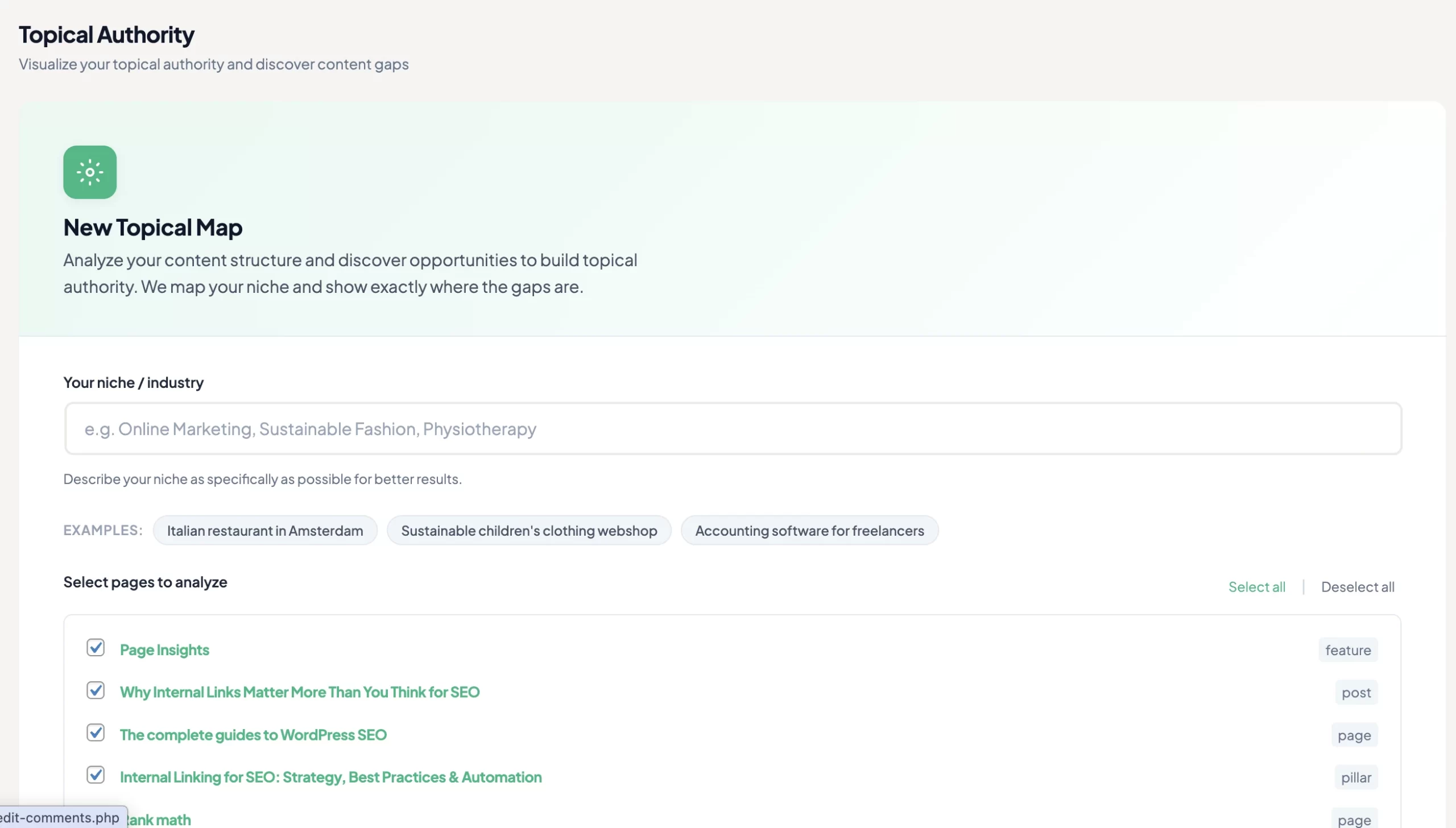
TamRank’s Topical Authority feature, part of the PRO add-on, reads your published pages from inside WordPress, so the inventory is complete by default, with no crawl ceiling. It already holds your Search Console data, and it groups pages into the topics they actually cover, which is the coverage-role dimension from step 2 done for you. The thin pages and the overlaps, the update and merge candidates, are surfaced rather than hunted for. It runs on Claude Haiku 4.5 and uses TamRank’s predictable credit model, 10 credits per 10 pages analysed.
It does not make the four decisions for you. Keep, update, merge and remove are judgement calls, and they should stay yours. What it removes is the hours of assembly before the judgement starts. You can see the Topical Authority feature or compare the free and PRO plans.
Content audit FAQ
What is a content audit?
A content audit is a structured, page-by-page review of everything a site has published, carried out to decide what to do with each page. It ends with one of four verdicts for every URL: keep, update, merge or remove. The metrics spreadsheet is the input; the verdicts are the audit.
Why does a content audit matter for SEO?
Because Google’s helpful content assessment is site-wide. A high proportion of weak or unhelpful pages can hold back the performance of a site’s genuinely helpful content. A content audit finds those weak pages so you can fix or remove them before they tax the rest of the site.
What should you do with underperforming pages?
It depends on why they underperform. A page with good bones that has aged should be updated. Two pages competing for one subtopic should be merged. A page with no demand and no place in your topical coverage should be removed. Deletion is the last option, not the default.
Should you delete old blog posts?
Only when they have no realistic path to being useful and cover nothing you are trying to rank for. Google’s guidance is that improving unhelpful content is usually better than deleting it. Deleting pages that could have been updated throws away ranking history you could have kept.
How often should you run a content audit?
A full content audit once a year suits most sites, with a lighter quarterly check on pages that are slipping or going out of date. A site that publishes heavily, or that builds content in clusters, can audit each cluster as it is completed instead of waiting for an annual sweep.
The bottom line
A content audit is not the spreadsheet. The spreadsheet is the inventory, and an inventory with no decisions in it has audited nothing.
The method is four steps: build a complete inventory, score every page on performance, quality, accuracy, intent and coverage role, give each page one of four verdicts, and rank the resulting work by impact over effort. Done properly, the output is a short, ordered action list, and most of what it asks for is improvement, not deletion.
For topical authority, the audit is the maintenance step that keeps a cluster from quietly decaying, because a cluster is only ever as strong as its weakest page. If you want the inventory and the coverage scoring built for you, so the audit starts at the judgement instead of the assembly, TamRank’s Topical Authority feature maps your published content and scores it.
Sources
- Google Search Central Blog, “What creators should know about Google’s August 2022 helpful content update,” on the site-wide nature of the helpful content signal and removing unhelpful content. Google developer documentation.
- Google Search Central, “Creating helpful, reliable, people-first content,” on the self-assessment of whether a page provides substantial value. Google developer documentation.
- Google Search Central, “What web creators should know about our March 2024 core update and new spam policies,” on the helpful content system folding into core ranking. Google developer documentation.

