A content gap analysis is sold as a tool job. Point a keyword gap tool at three competitors, export the list, and the list of keywords it hands back feels like the answer. It is not. That export is several hundred rows long, and most of those rows are noise: terms you do not want, cannot win, or that no longer mean what they did. The list is the input. The analysis is what you do to it.
This is the analysis as a decision process: how to find the gaps in your coverage from three angles, how to cut a long list down to the gaps that are actually worth filling, and how to decide whether each one needs a new page or a better one. The topical authority pillar names content gap analysis as part of the maintenance loop and leaves the method here.
- A content gap analysis finds the relevant topics you have not covered, or have covered worse than you could. The tool’s export is the input to it, not the result.
- Look for gaps from three angles: against competitors, against your own topical map, and against the questions real users ask.
- A keyword gap tool compares your domain against competitors and returns terms they rank for and you do not. Semrush calls these Missing and Untapped keywords.
- Most gaps are not worth filling. Prioritise on relevance, real demand, intent and whether you can realistically win.
- Ahrefs found 96.55% of pages get no traffic from Google. Filling a gap with a page that adds nothing just adds to that number.
What is content gap analysis?
Content gap analysis is the practice of finding relevant topics you have not covered, or could cover better, so you can decide what to publish or improve next. Semrush, whose Keyword Gap tool is one of the standard ways to run it, defines it as “finding relevant topics you haven’t covered or could cover better to improve your visibility in traditional search results and AI platforms”.
It is the natural complement to a content audit, and the two are easy to confuse. A content audit looks inward: it reviews the pages you already have and decides what to do with each. A content gap analysis looks outward and forward: it asks what is missing, what a thorough source on your subject would cover that you do not. The audit tells you the state of what exists. The gap analysis tells you what should exist and does not.
Why do content gaps matter?
A content gap is not an abstract tidiness problem. It is a specific, countable loss: a query where a searcher has a need, a competitor meets it, and you are not in the running. In the language of Google’s Search Quality Rater Guidelines, which ask raters to judge how fully a result meets the need behind a query, a gap is a query whose need someone else gets to satisfy.
For a site building topical authority the stakes are higher, because a gap is a hole in a cluster. The pillar makes the point that authority comes from covering a subject completely. Every meaningful subtopic you have not covered is a reason Google has not yet got the evidence to treat you as a source on the whole subject. Gap analysis is how you find those holes deliberately rather than discovering them when a competitor out-ranks you.
One honest warning to carry through the rest of this guide. Finding a gap is not the same as needing to fill it, and filling it is not the same as winning it. Ahrefs studied roughly 14 billion pages and found that 96.55% of them get zero traffic from Google. Most content fails. A gap filled with a thin, me-too page does not close the gap, it just joins that 96.55%. The whole point of the prioritisation and the information-gain test later in this guide is to make sure the gaps you fill are filled well enough to count.
How do you find content gaps?
Gaps hide from any single method, so look from three angles. Each one catches what the others miss.
1. Against your competitors
This is the angle the tools automate. A keyword gap tool compares your domain against a set of competitors and returns the terms they rank for and you do not. In Semrush’s Keyword Gap tool you compare against up to four competitors at once, and two filters do the work: “Missing” shows keywords every compared competitor ranks for but you do not, and “Untapped” shows keywords at least one competitor ranks for but you do not. Ahrefs’ Content Gap tool works on the same principle, returning the keywords competitors rank for in the top 100 that your site does not.
One discipline decides whether this angle is useful: choose real competitors. Not the biggest brand in your space, not an aspirational name, but sites at roughly your level that compete for the same subject. Compare against Wikipedia or a giant marketplace and the tool returns thousands of gaps you have no chance of winning. Compare against three genuine peers and the gaps it returns are gaps you could actually take.
2. Against your own topical map
Competitors only show you the gaps they have thought of. Your topical map shows you the gaps in your own plan. The map is the full layout of your subject, every subtopic it should contain. Lay your published pages over it and the unfilled rows are gaps by definition, subtopics you decided mattered and never wrote. This angle catches the gaps a competitor analysis cannot, because it measures you against the complete subject rather than against whoever happens to rank.
3. Against the questions real users ask
The third angle is the one tools serve worst. Keyword gap tools report what people type into Google often enough to register as volume. They miss the specific, low-volume questions that real readers actually have. Find those in the People Also Ask box, in the related searches, in Reddit threads and niche forums, and in your own Search Console: queries you already get impressions for, with no page that properly answers them, are gaps Google has handed you directly.
Run all three and the raw list is long. For a mid-sized site comparing against three competitors, the competitor angle alone can return 500 to 700 keyword gaps before the other two add more. That number is not a workload. It is the input to the next step, where most of it gets cut.
How do you prioritise which gaps to fill?
The export feels like a to-do list and it is not one. Most of those several hundred rows should never become content. Prioritising is the analysis, and it runs each gap through four questions.
- Is it relevant? Does this gap sit inside the subject you are building authority on, and does your site have a genuine reason to cover it? A gap that is off-subject is not your gap. Filling it dilutes the cluster rather than completing it.
- Is there real demand? Does the query have enough search volume, or clear enough value, to be worth a page? Some gaps are gaps because nobody is searching for them. Those are not losses.
- What is the intent? Every gap is a query with an intent behind it, and that decides what you would have to build. Matching content to search intent is its own skill, but at this stage the question is simpler: do you want to make the kind of page this gap demands?
- Can you win it? Be honest about whether you can realistically rank. A gap behind a wall of high-authority pages is a worse use of effort than a gap where the current results are weak. Semrush’s own advice is to filter by keyword difficulty and competitor position to focus on the winnable terms, and that advice is sound.
Run the list through those four and it collapses. The 500 to 700 raw gaps become, for most sites, 20 to 30 worth acting on. That collapse is the analysis doing its job. A content gap analysis that hands back a list almost as long as the export has not analysed anything; it has just relabelled the keyword tool’s output.
Should you create new content or improve existing content?
Each surviving gap resolves to one of two actions, and they are not equal in cost or in odds.
Sometimes the gap is genuine emptiness: there is no page on your site for this subtopic, so you create one. Sometimes the gap is a page you already have that covers the subtopic badly, too thin, too dated, aimed at the wrong angle. Then the action is to improve it, not to write a second page, and improving an existing page that already has some history and authority is usually faster and more reliable than starting from zero. Spotting which existing pages are improvement candidates is the job of the content audit, which is why the audit and the gap analysis are best run as a pair.
Whichever action a gap takes, one test sits over both. Whatever you publish has to add something the pages already ranking do not. Google holds a patent describing an information gain score, a measure of the additional information a document adds beyond what a searcher has already seen, and its guidance on helpful content asks whether a page offers substantial value compared with others in the results. A gap filled with a page that restates the current top results has gained nothing. It is a new URL with no new information, and it is how a site ends up contributing to that 96.55% rather than escaping it. The gap is only closed when the page that fills it deserves to outrank what is there.
Content gap analysis and the maintenance loop
Gap analysis is not a one-off. The subject moves, competitors publish, and your own map grows, so coverage that was complete drifts back into incomplete without you touching anything.
That is why it pairs with the content audit on a repeating cycle. The audit looks inward at the pages you have and scores their state. The gap analysis looks outward and forward at the pages you lack. Together they answer the whole maintenance question: is what we have still good, and is it still complete? Run on a sensible cadence, once or twice a year for most sites, alongside the audit, they are how a topical cluster stays whole instead of slowly falling behind the field.
How TamRank helps
The slow part of a gap analysis is the assembly: pulling competitor data, cross-referencing it against your own pages, and working out which gaps sit inside the subject you actually care about. The judgement, deciding which gaps are worth filling, is yours and should stay yours.
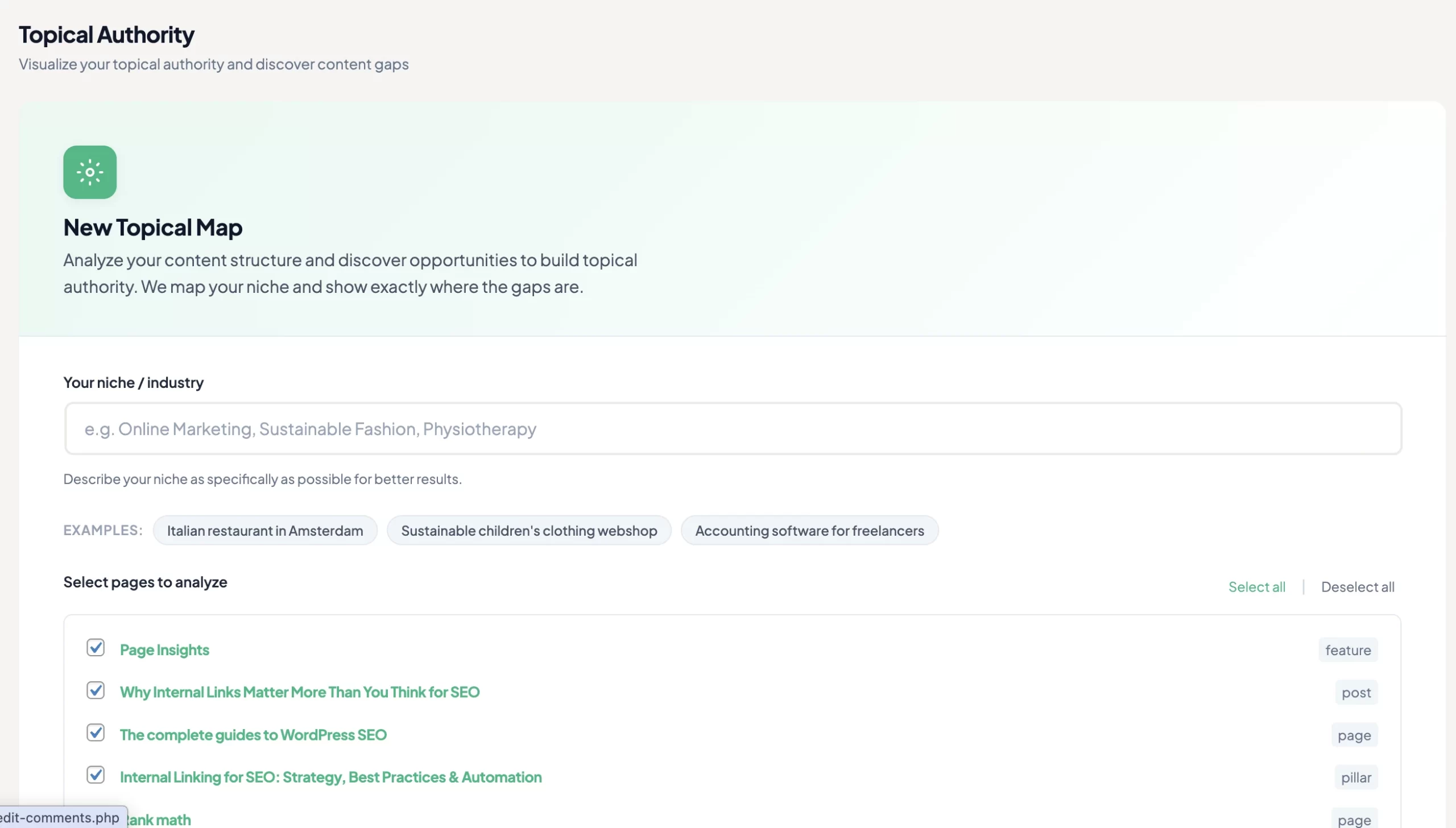
TamRank’s Topical Authority feature, part of the PRO add-on, helps with the assembly. It reads your published content as a body of work, groups it into the topics it covers, and scores that coverage, so the thin and missing areas of your own subject are visible without a manual cross-reference. That is the second angle from this guide, the gap against your own map, surfaced for you. It runs on Claude Haiku 4.5 and uses TamRank’s predictable credit model, 10 credits per 10 pages analysed.
It does not decide which gaps deserve a page, and it does not pretend coverage is a single number. It shows you where your subject is thin so the analysis starts from evidence. You can see the Topical Authority feature or compare the free and PRO plans.
Content gap analysis FAQ
What is content gap analysis?
Content gap analysis is the practice of finding relevant topics you have not covered, or could cover better, so you can decide what to publish or improve next. It looks outward at what is missing, where a content audit looks inward at the pages you already have.
How do you do a content gap analysis?
Find gaps from three angles: run a keyword gap tool against real competitors, check your published pages against your own topical map, and look at the questions users actually ask in People Also Ask, forums and Search Console. Then prioritise the gaps on relevance, demand, intent and winnability.
What is the best content gap analysis tool?
The standard tools are Semrush’s Keyword Gap and Ahrefs’ Content Gap, which both compare your domain against competitors and return the keywords they rank for and you do not. The tool matters less than the discipline: comparing against genuine competitors and then cutting the export down to the gaps worth filling.
How do you prioritise content gaps?
Run each gap through four questions: is it relevant to your subject, is there real search demand, what intent does it have, and can you realistically rank for it? Most gaps fail at least one. For a typical site a raw list of several hundred collapses to 20 to 30 worth acting on.
Should you create new content or improve existing content?
If no page covers the subtopic, create one. If a thin or dated page already covers it, improve that page rather than writing a second one, because an existing page often already has some ranking history. Either way, what you publish must add something the pages already ranking do not.
The bottom line
A content gap analysis is not the keyword tool’s export. The export is several hundred rows of raw possibility. The analysis is the work that turns it into a short list of gaps worth closing.
The method holds together in three moves. Find the gaps from three angles, against competitors, against your own topical map, and against the questions real users ask. Prioritise hard, on relevance, demand, intent and winnability, until a list of hundreds becomes a list of twenty. And fill each surviving gap with a page that adds something genuinely new, because a gap filled with a me-too page is not closed.
Paired with a content audit, gap analysis keeps a topical cluster complete as the subject moves. If you want the gaps in your own coverage surfaced before you start, TamRank’s Topical Authority feature maps your content and shows you where the subject is thin.
Sources
- Semrush (Vlado Pavlik), “Content Gap Analysis: A Step-by-Step Guide,” on the definition of content gap analysis and the Keyword Gap tool’s Missing and Untapped logic. semrush.com.
- Ahrefs (Tim Soulo), “96.55% of Content Gets No Traffic From Google,” a 2023 study of roughly 14 billion pages. ahrefs.com.
- Google Search Central, “Creating helpful, reliable, people-first content,” on whether a page provides substantial value compared with other results. Google developer documentation.
- Google patent “Contextual Estimation Of Link Information Gain” (filed 2018, granted June 2024), analysed by Search Engine Journal.
- Google, “Search Quality Rater Guidelines” (PDF, last updated 11 September 2025), on the Needs Met rating and how fully a result satisfies a query’s intent. guidelines.raterhub.com.

