Topical Authority for SEO: Strategy, Content Clusters & Maintenance
- Topical authority is not a Google ranking factor or a score. It is a model the SEO community uses to describe what Google’s helpful content and relevance systems already reward: deep, genuinely useful coverage of one subject.
- The model is worth using because the mechanisms underneath it are real. The helpful content system became part of core ranking in March 2024, and Google’s Information Gain patent describes scoring content on the new information it adds.
- A content cluster (one pillar page plus interlinked supporting articles) is the structure that turns a pile of separate posts into coverage Google can recognise as belonging together.
- Authority is not volume. The 2023 helpful content update and the March 2024 core update hit sites that mass-produced thin cluster content. Google said it aimed to cut low-quality, unoriginal content by roughly 40%.
- You never finish topical authority. Coverage decays as the subject moves and competitors publish, so the maintenance loop is the real long-term work.
What is topical authority?
Topical authority is the idea that a website ranks better across a whole subject when it covers that subject thoroughly and credibly, instead of chasing one keyword at a time. A site with topical authority on email deliverability does not just rank for “email deliverability”. It ranks for the bounce-rate question, the SPF and DKIM question, the shared-IP question, and a hundred narrower queries around them, because Google has come to treat the site as a dependable source on the subject as a whole.
That is the useful version of the idea, and it is worth building towards. Here is the part most articles skip.
The phrase itself comes from the SEO community, not from Google. The formal methodology around it, topical maps, semantic content networks, the language of “covering a topic”, was popularised by practitioners, most prominently Koray Tuguberk Gubur, who coined the term “topical map” and built a framework treating topical authority as a function of coverage, historical data and how easily a search engine can retrieve your content. It is a thoughtful model, but it is still a model.
So hold two things at once. Topical authority is a genuinely useful way to plan content, and it describes a real pattern in how strong sites rank. It is also not a dial inside Google’s algorithm that you switch on by publishing enough articles. The rest of this guide treats it that way: as a strategy that works, for reasons you should understand, with limits you should respect.
Is topical authority a Google ranking factor?
No. This matters, so it is worth being exact.
Google does not have a topical authority score. It does not have a site authority score of any kind. John Mueller of Google has said this directly: “In general, Google doesn’t evaluate a site’s authority. So it’s not something where we would give you a score on authority.” The third-party numbers that look like authority, Domain Authority, Domain Rating, Authority Score, are tool-maker inventions. Google does not use them, and there is no hidden Google equivalent.
What Google does have is more interesting, and it is why the topical authority model still works.
First, the helpful content system. Google launched it in August 2022 as a separate, named update aimed at sites with large amounts of unhelpful, search-engine-first content. In the March 2024 core update, launched on 5 March 2024, Google folded that system into its core ranking algorithm. The standalone classifier no longer runs on its own; helpfulness is now assessed continuously as part of core ranking. Google said it expected the update, with related changes, to reduce low-quality, unoriginal content in search results by about 40%.
Second, information gain. Google holds a patent called “Contextual Estimation Of Link Information Gain”, filed in 2018 and granted in June 2024. It describes an information gain score: a measure “indicative of additional information that is included in the document beyond information contained in documents that were previously viewed by the user”. In plain terms, it scores how much new a page adds on top of what the searcher has already seen. Be honest about the limit here: the patent’s described context is automated assistants and follow-up results, and a patent is not proof of a live ranking signal. But it tells you how Google’s engineers think about content value, and that thinking lines up with everything the helpful content system rewards.
Put those together and topical authority stops being mystical. It is a planning model that approximates what Google’s relevance and quality systems actually reward: a site that covers a subject in real depth, where each page adds something, and where the structure makes the depth legible. You are not gaming a score. You are building the thing the score, if there were one, would be trying to find.
What the evidence actually shows: the helpful content fallout
The clearest evidence about topical authority is not a study showing it works. It is the record of what happened to sites that misread it.
Between the August 2022 helpful content update and the March 2024 core update, a specific kind of site got hit hard: sites that took “cover the topic” to mean “publish at volume”. Programmatic clusters, hundreds of near-identical articles spun around keyword variations, AI-generated coverage with no first-hand input. Many of these sites had textbook topical structure on paper, a pillar and dozens of spokes, and still lost the majority of their traffic. Picture it concretely: an affiliate site with 300 articles, one for every variation of “best [product] for [use case]”, each assembled from the same spec sheets and the same handful of competitor reviews. On a topical map it looks like thorough coverage. To a reader, every page is the fortieth version of the page before it. The structure was right. The content was empty.
This is the single most important correction to make to the popular version of topical authority: authority is not volume. A cluster of 80 thin articles does not have more authority than a cluster of 20 substantial ones. It has less, because the helpful content system is now part of core ranking and it reads thin, repetitive coverage as a site-quality problem, not a quantity achievement.
Information gain is the same lesson from the other direction. If your fifteenth article on a subtopic repeats what the first fourteen results already say, its information gain is close to zero. It adds a URL to your site and nothing to the searcher. Worse, it can compete with your own better page for the same query. The question for every article in a cluster is not “does this keyword have volume” but “does this page contain something a reader cannot already get from the pages ranking above it”. If the answer is no, that article weakens the cluster instead of strengthening it.
None of this means coverage does not matter. It means coverage only counts when each piece of it earns its place. A cluster is only as authoritative as its weakest, thinnest page.
Content clusters: the structure topical authority runs on
Coverage needs a structure, or Google has no way to see it as coverage. That structure is the content cluster.
A content cluster has two parts. One pillar page covers the whole subject broadly, the page you are reading now is the pillar for topical authority. Then a set of supporting articles each cover one narrow subtopic in depth. The pillar links down to the supporting articles, the supporting articles link back up to the pillar, and related supporting articles link sideways to each other. This shape is sometimes called pillar-and-spoke or hub-and-spoke.
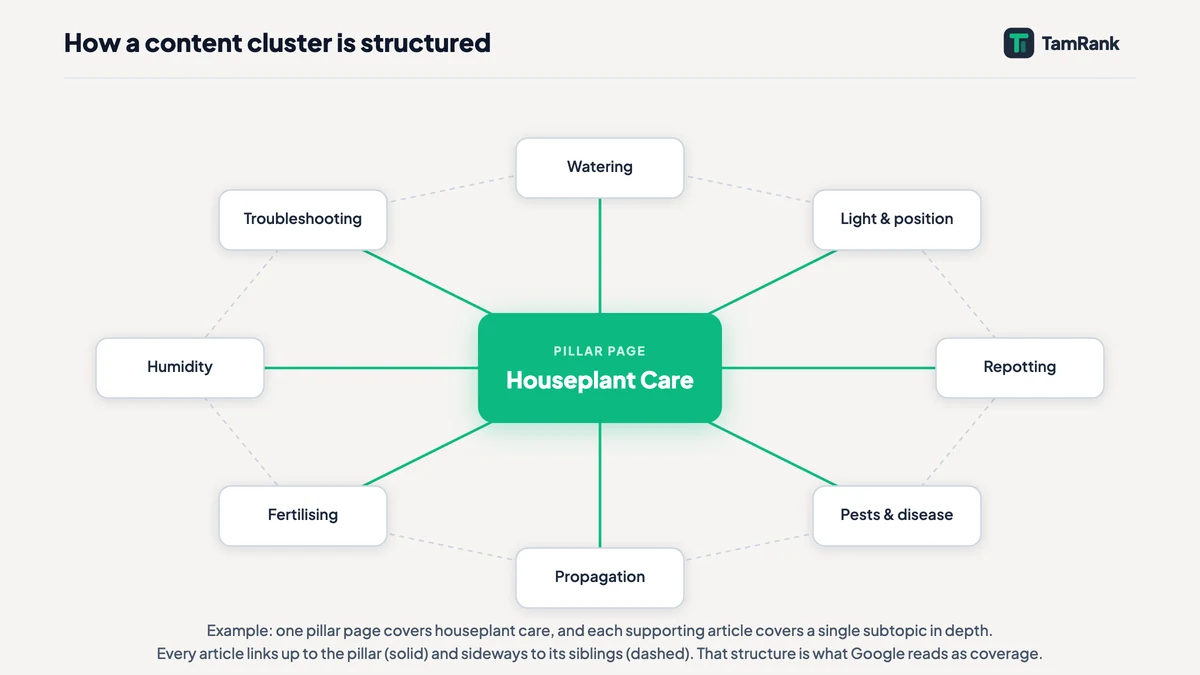
Take a simple example. A site about houseplant care has one pillar page on the subject as a whole, and supporting articles on watering, light and position, repotting, pests and disease, propagation, and the rest. Each supporting article goes deep on its one subtopic, while the pillar gives the overview and links down to each. Every supporting article links back up to the pillar and across to its siblings. That web of links is the structure.
The interlinking is not decoration. It is the mechanism. Google evaluates your site as a set of topics, not a flat list of pages, and internal links are the structural evidence that a group of pages belongs to one topic. Ten excellent articles on houseplant care that link to nothing read, to a crawler, as ten unrelated pages. The same ten articles, interlinked around a pillar, read as a body of work on one subject. The content is identical. The authority signal is not.
This is exactly where topical authority and internal linking meet, and it is why those two subjects are best read together. The cluster model decides what to write; internal linking decides how the pages connect once written. The full mechanics of link equity, anchor text and link structure are covered in the internal linking pillar. The dedicated guide to designing the cluster itself, pillar scope, how many spokes, where the boundaries sit, is one of the supporting articles in this cluster.
A practical warning. Do not build the structure before the content is worth structuring. A pillar page linking to 30 thin spokes is a well-organised version of the exact problem the helpful content system targets. Structure amplifies whatever it contains. Get the content right first, then the cluster shape compounds it.
How do you plan topical coverage? Build a topical map
A content cluster is the published result. A topical map is the plan you make before publishing anything.
A topical map is the full layout of a subject: every subtopic, every question, every angle a knowledgeable reader would expect a thorough source to cover, organised before you write a word. It is not a keyword list. A keyword list is what your tools hand you. A topical map is what you get after you have decided which of those keywords represent genuine subtopics, grouped them, found the gaps the tools missed, and arranged the whole thing into a structure.
Building one runs roughly like this. Start from the central subject and the reason your site has any business covering it, your actual expertise or product. Map the subtopics: the major divisions of the subject. Under each subtopic, list the real questions, the long-tail and question-shaped queries people bring to it. Then cluster that raw material, because keyword research returns a sprawl and many of those keywords are the same intent in different words. Grouping them into genuine subtopics is the step that turns a list into a map, and it is the same skill as keyword clustering.
To make that concrete, take one branch of a topical map for the houseplant care site. The subtopic is watering. Under it sit the questions a thorough source would answer: how often to water, the signs of overwatering, the signs of underwatering, whether tap water is a problem, how to water while away on holiday, and bottom watering versus top watering. Each of those is a candidate article. Repeat that for every subtopic and the map is the whole subject laid out as a structure, not a keyword dump.
The map gives you three things a keyword list never does. It shows the boundary of the subject, so you know what “complete” looks like. It shows the gaps, the subtopics every strong competitor covers and you have not planned. And it shows the order, because some articles are prerequisites for others and the map makes the dependencies visible. The detailed, step-by-step method for building a topical map is a dedicated guide in this cluster.
How many articles does topical authority take?
This is the most common question about topical authority, and the honest answer is that it is the wrong question.
There is no number. Not 20, not 50, not 100. The right amount of content is however much it takes to cover the subject completely, and the subject decides that, not you and not a target in a spreadsheet. A narrow, well-bounded subject, how to set up DMARC for a domain, say, might be genuinely complete at a dozen articles. A broad one, ecommerce SEO, can run past 150 and still have gaps. Both can have full topical authority, because authority is about completeness relative to the subject, not an absolute count.
Chasing a number is actively harmful. The moment “publish 50 articles” becomes the goal, you start writing articles to hit 50 rather than because a subtopic needs them. That is the exact path to the thin-cluster downgrade described earlier. You end up with article 47 existing only because 46 was not 50 yet.
Replace the count with a boundary. Your topical map defines the edge of the subject. An article belongs in the cluster if it covers a real subtopic inside that boundary and adds information a reader cannot already get from what ranks. An article does not belong if it exists to pad the count, or if it splits one subtopic into three near-identical pages to chase keyword variants. “Are we done” is not “have we hit the number”. It is “is every meaningful subtopic in the map covered, with genuine depth, and nothing more”. Coverage, not volume, and the map tells you when you have it.
How E-E-A-T and topical authority work together
Topical authority describes coverage. E-E-A-T describes credibility. You need both, and confusing them is why some thorough sites still under-rank.
E-E-A-T stands for Experience, Expertise, Authoritativeness and Trustworthiness. It comes from Google’s Search Quality Rater Guidelines, the manual Google’s human quality raters use to assess search results. Raters do not set rankings directly, but their guidelines tell you what Google is training its systems to value. E-E-A-T is not a score either. It is a description of what credible content looks like: first-hand experience, demonstrable expertise, recognition from others in the field, and basic trust signals like accurate information and a clear author.
Here is how the two interact. Topical authority is the horizontal axis, how much of the subject you cover. E-E-A-T is the vertical axis, how credibly you cover it. Wide coverage with no credibility is the thin-content cluster: every subtopic addressed, none of it convincing. Deep credibility with narrow coverage is the genuine expert who has published three excellent articles and ranks for almost nothing, because Google has no breadth of evidence that the site is a source on the subject. Topical authority done well is depth multiplied by credibility; done badly, it is a content farm with a sitemap. Strong topical authority needs both axes: the full map, covered by content that shows real experience and expertise on every page. The dedicated guide to E-E-A-T and topical authority in this cluster goes deeper into the practical signals.
Search intent and keyword research: where a cluster starts
Before the map, before the cluster, before any of the structure, there is a layer most topical authority advice rushes past: getting the intent and the keywords right for each individual article.
Every article in a cluster targets a query, and every query has an intent behind it: the searcher wants a definition, a comparison, a how-to, or they want to buy. An article that targets a question with the wrong intent fails regardless of how good the cluster around it is. A buying-intent query answered with a 2.000-word explainer will not rank, because that is not what the searcher, or Google, wants there. Matching each article to its real search intent is covered in the search intent guide in this cluster.
Keyword research feeds the map, and the most valuable part of it for a cluster is the long tail: the specific, lower-volume, often question-shaped queries that make up the bulk of search. They are where topical authority pays off first. You will rank for long-tail queries inside a well-covered subject long before you rank for the competitive head term, and they convert better because the intent is sharper. Our guide to long-tail keywords covers how to find them and why they convert. Those long-tail queries are the raw material of the topical map, and a cluster planned without them tends to cover the obvious subtopics and miss the specific questions that actually win traffic.
How do you maintain topical authority?
Topical authority is not a project with an end date. It is a position you hold, and positions erode.
Three forces erode it. The subject moves, so an article that was accurate two years ago now describes a tool, a default or a best practice that has changed. Competitors publish, so coverage that was complete relative to the field becomes incomplete without you touching it. And your own site accumulates mistakes: two articles that drift into competing for the same query, a subtopic you meant to cover and never did. Left alone, a cluster that was strong at launch is mediocre within eighteen months.
The maintenance loop has four moving parts, and each is a dedicated guide in this cluster.
A content audit is the inventory: every URL in the cluster, scored on performance, accuracy and depth, so you know what you actually have rather than what you think you have. Content gap analysis compares your coverage against two things, the competitors ranking for your subject and your own topical map, and returns the subtopics you are missing. Content decay is the slow ranking slide of pages that were fine and have aged. A 2023 guide to Core Web Vitals that still optimises for FID, the metric Google replaced with INP in 2024, is decaying in plain sight; the fix is a deliberate refresh, not a rewrite. Content cannibalisation is two or more of your pages competing for the same query, splitting signals that should sit on one URL. A “how to write meta descriptions” post and a separate “meta description length” post will often both rank, weakly, for meta description; the fix is to consolidate, differentiate or redirect.
This is also how you measure topical authority, because there is no single metric for it. Measure it as a spread. How much of your topical map is published and interlinked. What share of the cluster’s URLs rank in the top 10. And the clearest signal of all: whether you are ranking for queries you never targeted directly. When a cluster starts pulling traffic on long-tail terms that are not in your map, Google is treating the site as a source on the subject rather than a set of pages. That is topical authority becoming visible in the data.
A worked example: building a cluster from zero
Abstract advice is easy to nod along to and hard to act on, so here is a concrete walk-through. It is a clearly labelled illustrative scenario, representative of the work rather than one specific client.
An in-house SEO at a B2B email platform is told to “own email deliverability in search”. They start with a topical map, not a content calendar.
Mapping. They define the boundary: deliverability from a sender’s point of view, which excludes adjacent subjects like email design and list buying. Inside that boundary they map the subtopics: authentication (SPF, DKIM, DMARC), reputation (IP and domain), infrastructure (shared versus dedicated IP, warm-up), engagement signals, bounces and complaints, blocklists, and diagnostics. Under each subtopic they list the real questions. The raw keyword research returns about 140 terms. After clustering out the duplicates and the off-boundary noise, the map settles at 1 pillar and 21 supporting articles.
Sequencing. They do not publish in keyword-volume order. They publish in dependency order: the pillar and the foundational subtopics first, because later articles will link to them, then the question-level articles that link into those. At a sustainable two articles a week, the 22-page cluster takes about eleven weeks to publish.
What happens, and when. The first few articles rank within three to five weeks, mostly on specific long-tail questions with little competition. The pillar barely moves at first; broad head terms are slow. The shift worth waiting for comes later. Roughly four to six months after the cluster is reasonably complete and interlinked, they start ranking for queries that were never in the map, the unplanned long tail, and the pillar begins climbing for the competitive head term. That is the compounding effect, and it is the actual return on topical authority. It does not arrive in week two, and any source promising that it does is selling something.
Then maintenance begins. Authentication standards change, so the DMARC article needs a refresh within the year. A competitor publishes a strong piece on a subtopic the map underweighted, so a gap analysis catches it. Two articles on bounce handling drift into cannibalising each other and get consolidated. The cluster is never “finished”. It is held.
How TamRank helps you build topical authority
Most of the work above is judgement, and judgement does not automate. What does automate is the part that is tedious and easy to skip: knowing where your coverage actually stands.
TamRank’s Topical Authority feature, part of the PRO add-on, analyses your existing content as a body of work rather than a list of posts. It groups your published pages into the topics they actually cover, shows where coverage is thin against the subject you are targeting, and surfaces the gaps and the cannibalisation that a manual audit takes hours to find. It runs on Claude Haiku 4.5, and it uses TamRank’s predictable credit model: 10 credits per 10 pages analysed, so the cost is something you can see before you run it, not a surprise on the invoice.
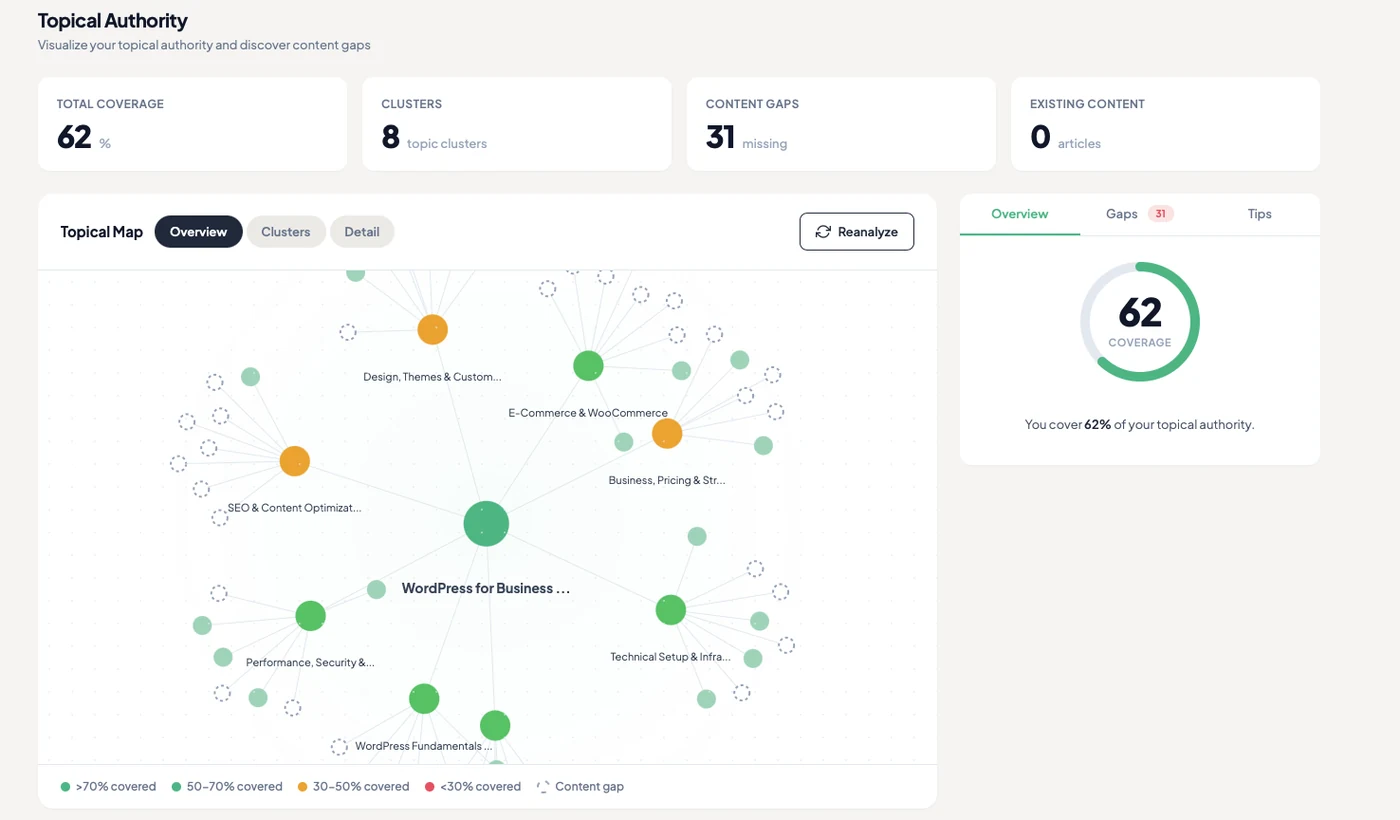
It does not write the articles, and it does not pretend coverage is a number. It tells you, honestly, where the cluster is strong and where it is hollow, so the writing effort goes where it changes rankings. TamRank PRO is an add-on on top of the free plugin, the same model Yoast and Rank Math use. You can see the Topical Authority feature in detail, or compare the free and PRO plans to see where it sits.
The verdict
Topical authority is one of the most useful planning models in SEO and one of the most misunderstood. It is not a Google ranking factor, not a score, and not something you earn by publishing at volume. It is a description of what Google’s helpful content and relevance systems reward: a site that covers a subject completely, where every page adds something real, organised so the depth is legible.
Five things worth doing:
- Drop the article-count target. Replace “publish 50 articles” with a topical map that defines where the subject ends.
- Build the map before the calendar. Cluster your keyword research into genuine subtopics, and find the gaps your tools missed.
- Apply the information gain test to every planned article: does this page add something a reader cannot already get from what ranks. If not, cut it.
- Build the cluster structure, pillar and interlinked spokes, but only once the content is worth structuring.
- Schedule the maintenance loop. Audit, gap analysis, decay refresh and cannibalisation checks are the work that holds the position after launch.
If you want an honest read on where your coverage stands before you plan the next cluster, TamRank’s Topical Authority feature maps your existing content and shows you the gaps. Start from what you already have, because that is usually where the fastest wins are.
Sources
- John Mueller (Google), on Google not evaluating site authority, reported by Search Engine Journal.
- Google Search Central, “What web creators should know about our March 2024 core update and new spam policies,” 5 March 2024. Google developer documentation.
- Search Engine Land, Google Helpful Content Update timeline (launched August 2022, folded into core March 2024). searchengineland.com.
- Google patent “Contextual Estimation Of Link Information Gain” (filed 2018, granted June 2024), analysed by Search Engine Journal.
- Koray Tuguberk Gubur, on topical authority and topical maps. Medium.
- Google Search Central, “Creating helpful, reliable, people-first content.” Google developer documentation.

