E-E-A-T gets treated as a checklist. Add an author box, write an about page, drop in a few outbound links, tick the box. That misreads what the four letters are. They are not settings you switch on. They describe whether a real person with real standing made something worth trusting, and that is not a thing you bolt onto a finished page.
The topical authority pillar covers the relationship between the two ideas at a concept level: topical authority is how much of a subject you cover, E-E-A-T is how credibly you cover it, and you need both. This guide is the practical half the pillar deferred. What does each of the four signals actually look like on a page, how do you demonstrate them honestly, and how does that change when you are building a whole cluster rather than a single article.
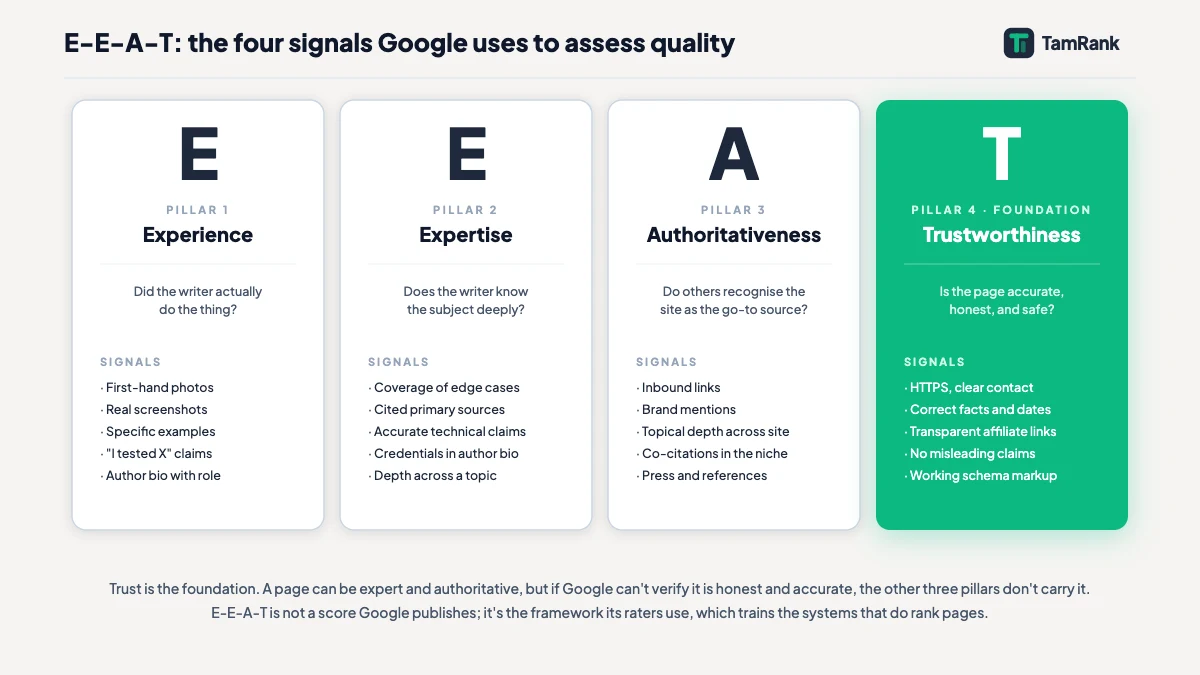
- E-E-A-T stands for Experience, Expertise, Authoritativeness and Trust. It comes from Google’s Search Quality Rater Guidelines, and Google states plainly that of the four, trust is the most important.
- It is not a ranking factor and not a score. Around 10,000 human raters use it to assess search results, and their assessments help Google evaluate its ranking systems rather than setting rankings directly.
- Experience and Trust are the two most concrete to act on: show genuine first-hand use, and be accurate, transparent and honest about limitations.
- Authoritativeness is the one you cannot self-declare. It is recognition by others, earned off-page and slowly.
- Topical authority is a cluster-level idea, so E-E-A-T has to hold across the whole cluster. Consistent authorship and one weak, untrustworthy page both move the credibility of every page around them.
What is E-E-A-T?
E-E-A-T stands for Experience, Expertise, Authoritativeness and Trustworthiness. It comes from Google’s Search Quality Rater Guidelines, the manual that instructs around 10,000 external human raters on how to assess the quality of search results. Those raters do not set rankings. Their assessments are used to evaluate and improve Google’s ranking systems, which means E-E-A-T is a description of what Google wants its algorithms to reward, not a control panel inside them.
So E-E-A-T is not a ranking factor and not a score. There is no E-E-A-T number on your site. What it is, in Google’s own words from its Search Central documentation, is a way of describing content credibility, where “trust is most important. The others contribute to trust.” Experience, expertise and authoritativeness are the three things that, when present, make a page trustworthy. Trust is the point; the other three are how you get there.
How does E-E-A-T relate to topical authority?
Topical authority and E-E-A-T answer two different questions about a site. Topical authority asks how much of a subject you cover: the breadth, the cluster, the completeness. E-E-A-T asks how credibly you cover it: the depth of standing behind each page. A site can score well on one and badly on the other, and both failure modes under-rank.
The pillar sets out that interaction in full. What it leaves to this guide is the practical consequence, and there is one that matters more than any single tactic. E-E-A-T is almost always discussed at the level of one page, but topical authority is a cluster-level idea. You are not trying to make one article credible, you are trying to make a body of 30 articles read as the work of a credible source. That changes how you apply every signal below, which is why the last section returns to it deliberately. First, the four signals themselves.
Experience: showing you have actually done it
Experience is the newest of the four. Google added it to the framework in December 2022, turning E-A-T into E-E-A-T, and it asks a blunt question: was this content produced with genuine first-hand experience of the subject? Has the writer actually used the product, run the process, visited the place?
It is also the most concrete to act on, because experience leaves marks that are hard to fake. The practical signals are specific. Original screenshots of the actual tool, not stock images or the vendor’s marketing shots. Your own photographs. Real numbers from something you ran yourself. And above all, the detail only a practitioner knows: the step the official documentation skips, the point where the process usually breaks, the workaround that is not written down anywhere.
A short contrast makes it concrete. Two articles explain how to migrate a WordPress site. The first lists the steps in order, accurately, in the sequence the documentation gives them. The second says the redirect map is where this goes wrong, that on the last migration a caching plugin silently kept serving old URLs for a day, and that you only catch it by watching Search Console for the 404 spike in the days after. Both are accurate. Only the second demonstrates experience, and nothing about the structure or the keyword changed. The difference is entirely in whether someone had actually done it.
This is also why mass-produced content fails the experience bar so reliably. Expertise can sometimes be researched and summarised convincingly. First-hand experience cannot, because the specific, unglamorous detail is not in the sources to summarise. If you have genuinely done the thing, the fix is simply to put the evidence of that on the page instead of editing it out in favour of a cleaner, more generic version.
Expertise: showing you actually know the subject
Expertise is demonstrable knowledge of a subject. The word that matters is demonstrable: expertise is shown in the content first and declared in the byline second, not the other way round. A credentials line under the title does nothing if the article itself is shallow.
In practice, expertise shows up as depth and accuracy. An expert page is correct on the details, uses the field’s concepts properly, and does not flinch at the hard or contested parts of the subject. A page that only covers the comfortable, well-trodden 80% of a topic reads as competent. A page that also handles the awkward edge cases, the exceptions, the bits where the common advice is wrong, reads as expert. That difference is visible to a reader and it is visible to Google’s systems through how thoroughly the page satisfies the query.
Google’s guidelines also recognise that expertise is not only formal. For a medical or legal subject, professional qualifications carry the weight. For a great many subjects, what the guidelines call everyday expertise is what counts: someone who has done a thing several hundred times has real expertise in it, credential or not. A freelance SEO who has run 60 site migrations has migration expertise. The job is to make that legible, through the author’s background and through content that could only come from that depth.
Here is where expertise and topical authority meet directly. A single deep article demonstrates expertise on one narrow subtopic. A complete cluster, every subtopic in a subject covered with that same depth, demonstrates expertise on the subject as a whole. The breadth is itself the signal. This is the credibility argument for covering a subject properly rather than publishing three popular articles and stopping.
Authoritativeness: being recognised by others
Authoritativeness is the awkward one, because it is the only signal of the four you cannot put on your own page. Experience, expertise and trust are things you demonstrate. Authority is something other people grant you. It is the extent to which your site, or your author, is recognised by others as a go-to source on the subject.
That makes the practical signals indirect. Authority shows up as other sites citing and linking to yours as the reference. It shows up as the author being known in the field through work that happens off your site: contributing elsewhere, speaking, being quoted. It shows up, over time, as your page becoming the one that ranks because everyone treats it as the source. You influence it, but you cannot write it into existence in an afternoon.
Be honest about the limits here, because this is where E-E-A-T advice tends to oversell. Authority is the slowest of the four to build and the least under your control. A new site with genuine experts producing genuinely expert content will have real Experience, Expertise and Trust long before it has Authoritativeness, and that is normal, not a failure. The pillar makes the related point that topical authority and link authority are different levers; authoritativeness in the E-E-A-T sense sits close to link authority, and it accrues on the same slow timeline.
What you can do is earn it deliberately. The most reliable route is the same body of work that builds topical authority: a genuinely complete, genuinely expert cluster on one subject is the thing that makes other people in the field cite you, because you have become the obvious place to point to.
Trust: the signal everything else feeds
Trust is the centre of the framework. Google is unambiguous about this in its Search Central documentation: “trust is most important. The others contribute to trust.” Experience, expertise and authoritativeness are not four equal boxes to tick. They are three inputs to the one output that matters.
The consequence is strict. A page can demonstrate real experience, real expertise and real authority, and still fail E-E-A-T if it is not trustworthy, because untrustworthiness overrides the rest. So the trust signals are worth being concrete about:
- Accuracy. Claims are correct and, where they are not common knowledge, sourced. A single confidently wrong statement does more damage than a paragraph of vague writing.
- Transparency. A reader can tell who runs the site, who wrote the page, and how to make contact. Commercial relationships, affiliate links and sponsorships are disclosed rather than hidden.
- Honesty about limits. The page says when its advice does not apply, when something is contested, and when the honest answer is “it depends”. Overclaiming is a trust cost, not a persuasion win.
- Basic site integrity. The site is secure, the page is not buried in deceptive advertising, and mistakes get corrected when they are found rather than left to stand.
Trust is also where the YMYL idea comes in. Google applies extra weight to E-E-A-T on what it calls Your Money or Your Life topics: subjects that can affect a person’s health, financial stability or safety. SEO advice is not YMYL, so the bar is not life-and-safety high. But the trust signals above are not reserved for YMYL subjects. They are the baseline, and on a commercial site, where a reader knows you also sell something, clearing that baseline visibly is what lets the expertise land.
One worked contrast. An article written by a genuine expert recommends a specific tool, and the link to that tool is an undisclosed affiliate link. The experience is real, the expertise is real. The undisclosed commercial relationship is a trust failure, and under Google’s framing it pulls the whole page’s E-E-A-T down regardless of how good the rest is. Disclosing the link costs nothing and removes the problem.
What are the “Who, How and Why” questions?
Google translates E-E-A-T into three plain questions any creator can ask of a page, and they are the most useful checklist in this whole subject because they come straight from Google’s documentation rather than from SEO interpretation.
Who created the content. A reader, and a search engine, should be able to tell. That means a real byline, not “admin” or “editorial team”, and an author bio that states the background relevant to this subject. Authorship is the single most common gap on otherwise good content.
How the content was made. Be transparent about the process, including any use of automation or AI. Google has been clear that it judges content on quality rather than on whether a human or an AI produced it, but it expects honesty about the method where that would matter to a reader. A page built largely by AI and presented as one person’s hard-won experience is a How problem and a Who problem at once.
Why the content exists. This is the decisive one. Content should exist primarily to help the person reading it. Content made primarily to rank, with helping the reader as a side effect, is exactly what Google’s helpful content assessment, now part of core ranking, is built to find. If the honest answer to “why does this page exist” is “to capture the keyword”, no amount of author-box polish fixes it.
E-E-A-T across a cluster, not just a page
Everything above applies to a single page. Topical authority is built from a cluster, so the last move is to apply E-E-A-T at cluster scale, and three things change when you do.
First, authorship has to be consistent. A cluster of 30 articles credited to one or two named experts compounds its Who signal: each new article strengthens the author’s visible track record on the subject. The same 30 articles split across a rotating cast of anonymous freelancers does the opposite, scattering the signal instead of building it. If you are serious about a subject, put a consistent, real author on its cluster.
Second, the cluster itself becomes the expertise signal. No single page can prove you are a source on an entire subject. Thirty genuinely expert articles, each handling its subtopic with real depth, prove it together in a way none of them could alone. This is the same point the pillar makes about coverage, seen from the credibility side: breadth, done well, is itself evidence of expertise.
Third, the weak page drags the rest. The pillar puts it directly: a cluster is only as authoritative as its weakest, thinnest page. The E-E-A-T version is the same warning. One inaccurate, untrustworthy or obviously thin article inside a cluster does not just rank badly itself. It tells a reader, and Google’s systems, something about the standards of every other page around it. When you audit a cluster for E-E-A-T, the worst page matters more than the best one. The credible cluster has a high floor, not just a high ceiling.
How TamRank helps
E-E-A-T is earned, not configured. A plugin cannot give you first-hand experience, cannot make other people cite you, and should not pretend otherwise. Most of the work in this guide is judgement and genuine effort, and that is correct.
What a tool can do is two narrower things. The first is making the signals you have earned legible to a search engine: author and article structured data, so the authorship and credentials you have established are machine-readable rather than left for Google to infer. TamRank’s schema tools handle that markup. The second is the cluster view. TamRank’s Topical Authority feature, part of the PRO add-on, shows your content as the body of work it forms, so the thin page that drags a cluster’s credibility is visible instead of hidden in a long post list. It runs on Claude Haiku 4.5 and uses TamRank’s predictable credit model, 10 credits per 10 pages analysed.
Neither writes the credible content for you. They make sure the credibility you have built is visible and that the weak link is easy to find. You can see the Topical Authority feature or compare the free and PRO plans.
E-E-A-T FAQ
What does E-E-A-T stand for?
E-E-A-T stands for Experience, Expertise, Authoritativeness and Trustworthiness. It comes from Google’s Search Quality Rater Guidelines and describes what credible, helpful content looks like. Google states that of the four, trust is the most important, and the other three contribute to it.
Is E-E-A-T a ranking factor?
No. E-E-A-T is not a ranking factor and not a score. It is a set of criteria that around 10,000 human quality raters use to assess search results. Those assessments help Google evaluate its ranking systems; they do not directly set rankings. E-E-A-T describes what Google trains its systems to reward.
Which part of E-E-A-T matters most?
Trust. Google’s documentation says plainly that “trust is most important” and that experience, expertise and authoritativeness contribute to it. A page can show all three and still fail E-E-A-T if it is inaccurate, deceptive or not transparent, because untrustworthiness overrides the rest.
How do you improve E-E-A-T?
Show genuine first-hand experience with specific detail, cover subjects with real depth, put a clear named author with relevant background on the content, and be accurate and transparent. Authoritativeness is earned off-page over time through recognition by others and cannot be added directly.
Does E-E-A-T apply to AI-generated content?
Yes. Google judges content on quality rather than on whether a human or AI produced it, but it expects transparency about how content was made. AI-generated content still has to demonstrate experience, expertise and trust, and presenting AI output as one person’s first-hand experience is a transparency failure.
The bottom line
E-E-A-T is not a checklist and not a score. It is Google’s description of whether a credible source made something worth trusting, with Trust at the centre and Experience, Expertise and Authoritativeness feeding into it.
Three of the four are things you can act on directly. Show real experience with the specific detail only a practitioner has. Show expertise through depth and accuracy on the hard parts, not just the easy ones. Earn trust by being accurate, transparent and honest about limits. Authoritativeness is the one you cannot shortcut; it comes from other people, slowly, and a genuinely complete and expert cluster is the most reliable way to earn it.
For topical authority, the move that matters is to stop thinking page by page. A credible cluster has consistent authorship, depth on every subtopic, and no weak page dragging the rest down. If you want to see your content as the body of work Google reads it as, and find the thin page before it costs you, TamRank’s Topical Authority feature maps your coverage and surfaces the gaps.
Sources
- Google Search Central, “Creating helpful, reliable, people-first content,” on the E-E-A-T definitions, trust being most important, the Who/How/Why framework and YMYL. Google developer documentation.
- Google, “Search Quality Rater Guidelines” (PDF, last updated 11 September 2025), on the role of quality raters and the E-E-A-T criteria. guidelines.raterhub.com.
- Google Search Central Blog, “Our latest update to the quality rater guidelines: E-A-T gets an extra E for Experience,” December 2022. Google developer documentation.

