Content cannibalization is the most over-diagnosed problem in SEO. You look at Search Console, see two of your own pages ranking for one keyword, and it looks like a crisis: your pages are fighting each other, splitting your traffic, holding each other down. So you panic, merge them, and sometimes make things worse.
Most of the time, two pages ranking for one keyword is fine. Real cannibalization is narrower and rarer than the label suggests, and the first and most valuable skill is telling the real thing from the false alarm. The topical authority pillar names cannibalization as part of the maintenance loop. This guide is how to diagnose it honestly and fix only what actually needs fixing.
- Content cannibalization is two or more of your pages competing for one query with the same intent, splitting signals that should sit on one URL.
- It is heavily over-diagnosed. Google’s John Mueller has said more than one page ranking for a query is not inherently a problem.
- The test is intent, not keyword. Two pages on one keyword with genuinely different intents are fine and should be left alone.
- Detect it in Search Console: look for a query where the ranking URL keeps swapping between two of your pages.
- There are three fixes: consolidate the pages into one, differentiate them into genuinely separate intents, or redirect the weaker one.
What is content cannibalization?
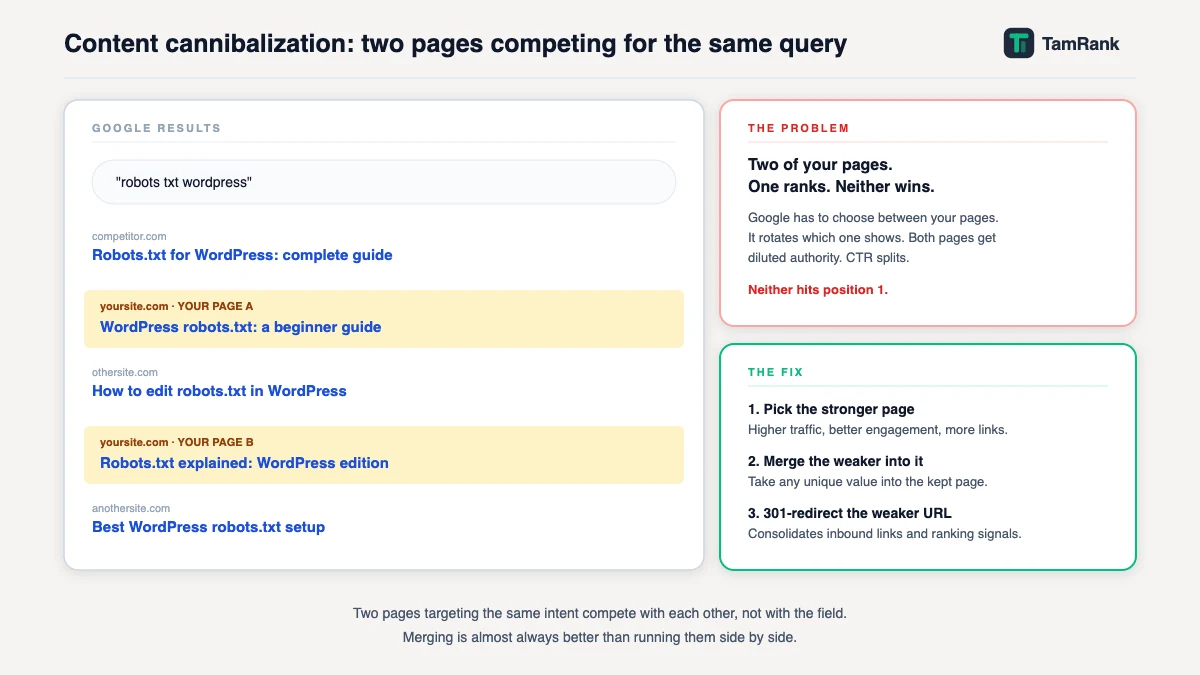
Content cannibalization, also called keyword cannibalization, is when two or more pages on your own site compete for the same search query, so that the signals which should consolidate on one strong page are split across several weaker ones. The links, the relevance and the click history that could have made one page rank well are divided, and you end up with two pages ranking mediocrely instead of one ranking well.
The word that defines it, and the word most definitions skip, is intent. Cannibalization is not two pages that share a keyword. It is two pages that serve the same search intent. Two pages can both contain the phrase “meta description” and not compete at all, if one answers “what is a meta description” and the other answers “meta description length limit”, because those are different intents and Google ranks them for different queries. Cannibalization is specifically when two pages are trying to be the answer to the same question. Hold onto that distinction, because the next section is built on it.
Is keyword cannibalization actually a problem?
Often, no. This is worth saying plainly, because the standard SEO advice treats every instance as urgent, and that advice causes real damage when people merge pages that were working.
Google’s John Mueller addressed this directly in a September 2025 Q&A. His position: more than one page ranking for a query is not inherently a problem. In his words, “if you have 3 different pages appearing in the same search result, that doesn’t seem problematic to me just because it’s ‘more than 1’.” He went further, calling the concept itself loose: it is “not really ‘cannibalization’ if it’s theoretical”. You have to look at the actual site and the actual users, not at a count of URLs.
Mueller also made the point that matters most for diagnosis: the label “keyword cannibalization” tends to hide the real problems rather than name one. When a site genuinely under-performs, the cause is usually something specific, thin content, near-duplicate pages, an unfocused or overly long page, weak internal linking, and “cannibalization” is a vague word draped over it. Chasing the label means chasing a symptom.
So treat the panic version with suspicion. Two pages ranking for one keyword, both healthy, both with their own steady traffic, is not a problem to fix. Real cannibalization is the narrower case where genuinely competing pages are measurably weakening each other, and the rest of this guide is about finding and fixing that case, not the false alarm.
How do you detect content cannibalization?
Detecting real cannibalization takes two steps: find the candidates, then apply the intent test. Skip the second step and you are back to chasing the label.
Find the candidates in Google Search Console. In the performance report, look at individual queries and check which of your pages receive impressions for each one. A query where two or more of your URLs both pick up impressions is a candidate. The strongest single signal is instability: open a candidate query, watch which URL Google ranks for it over time, and if that URL keeps swapping between two of your pages from week to week, Google is telling you plainly that it cannot decide which of them should be the result. That swapping is the clearest fingerprint of genuine cannibalization.
Then apply the intent test, because a candidate is not yet a confirmed case. Take the two pages and ask whether they serve the same search intent. Two checks settle it. Read both pages: are they genuinely trying to answer the same question, or two different questions that happen to share words? And check the SERP: when the same set of competitor URLs ranks for the queries both your pages target, Google considers those queries one intent, and your two pages are competing for real. When the SERPs are different, the intent is different and the pages are not cannibalizing, whatever the keyword overlap looks like.
A quick worked case. A site has two posts, “how to write email subject lines” and “email subject line tips that work”. Search Console shows the ranking URL for the query “email subject lines” swapping between the two from one month to the next. Reading both pages, they give the same advice to the same reader, and the SERP for each is the same set of competitors. That is a confirmed case: same intent, genuine competition. A third post on the same site, “email subject line length”, shares the words but draws a different SERP, so it never makes the list.
The outcome of detection is a short, honest list. For most sites it is far shorter than the panic version suggests: a handful of query and page pairs where two same-intent pages genuinely compete, separated cleanly from the larger pile of pages that merely share words and are working fine. Only the short list goes to the next step.
How do you fix content cannibalization?
A confirmed case of cannibalization has three possible fixes, and the right one depends on a single question: should these genuinely be two pages, or one?
Consolidate. If the two pages are really one article split in two, merge them. Combine the best of both into the stronger page, the one with more traffic, links and history, and 301-redirect the weaker URL to it. This is the most common fix, because most genuine cannibalization is one subject that was accidentally written twice. Google’s canonicalization guidance is explicit that a redirect is a strong signal to consolidate the ranking signals of both URLs onto one, so the merged page inherits the links and history of both rather than splitting them.
Differentiate. If the two pages could legitimately be two articles but currently overlap too much, re-scope them. Sharpen each one to a genuinely distinct intent or angle so they stop answering the same question. The “meta description” example resolved this way: rewrite one to own “how to write a meta description” and the other to own “meta description length”, until the SERPs for the two pull apart. Differentiate when there is a real reason for two pages; consolidate when there is not.
Redirect. If one of the two pages is simply the weaker, older or thinner one with nothing worth preserving, do not merge anything. 301-redirect it to the better page and move on. This is consolidation without the editing step, for when one page has no content worth carrying over.
One lighter option sits alongside these three. Sometimes the pages mostly belong as they are and the signals are just split untidily. Then the fix is internal linking: point internal links, with consistent descriptive anchor text, at the page that should win the query, so your own site stops casting an even vote between them. Reach for this when neither merging nor redirecting is right but one page clearly should be the primary. And take Mueller’s warning into the decision: if the real problem turns out to be thin content or an unfocused page, fix that, because no merge or redirect repairs a page that was weak to begin with. Choosing between these fixes, page by page, is also part of what a content audit decides when it returns a merge verdict.
How do you prevent content cannibalization?
Every fix above is rework, and rework is avoidable. Genuine cannibalization is almost always a planning failure: two articles commissioned for what was really one intent, because nobody checked before writing.
The check belongs at the planning stage, in the topical map. Before two keywords become two articles, test whether they are actually one intent: if the same pages rank for both in Google’s results, they are one article, and planning them as two builds cannibalization in on purpose. The discipline of one subtopic per article, applied when the map is drawn, is what stops it. Matching each article to a clear, single search intent is the same safeguard from the other direction. Cannibalization fixed after publication is a redirect and a rewrite; cannibalization prevented at the map is a row you simply did not duplicate.
How TamRank helps
The detection step, finding the queries where two of your pages both rank and watching for the URL that keeps swapping, is a repetitive trawl through Search Console data. That is the part worth automating.
TamRank connects to Google Search Console from inside WordPress and reads the query and page data together, so the queries where more than one of your URLs competes are surfaced rather than hunted for manually. That gives you the candidate list. The judgement, applying the intent test and choosing between consolidate, differentiate and redirect, stays with you, because as Mueller’s point makes clear, that judgement is exactly where the label “cannibalization” usually goes wrong.
It will not merge pages for you, and it will not tell you two healthy pages are a crisis when they are not. It shows you where your own URLs genuinely compete, so you can fix the real cases and leave the false alarms alone. You can see how it fits in the features overview or compare the free and PRO plans.
Content cannibalization FAQ
What is content cannibalization?
Content cannibalization is when two or more pages on your own site compete for the same search query with the same intent, splitting the signals that should consolidate on one page. The defining factor is shared intent, not a shared keyword.
Is keyword cannibalization actually bad for SEO?
Not always. Google’s John Mueller has said more than one page ranking for a query is not inherently a problem. Real cannibalization is the narrower case of same-intent pages genuinely weakening each other. Two pages on one keyword with different intents are fine and should be left alone.
How do you detect content cannibalization?
In Google Search Console, find queries where two or more of your pages get impressions. The strongest signal is instability: if the URL Google ranks for a query keeps swapping between two of your pages, it cannot decide between them. Then confirm the two pages share the same search intent.
How do you fix keyword cannibalization?
Three fixes, depending on whether the pages should be one or two. Consolidate: merge them and 301-redirect the weaker URL. Differentiate: re-scope each to a genuinely distinct intent. Redirect: if one page has nothing worth keeping, redirect it to the better one.
Should you merge pages that rank for the same keyword?
Only if they serve the same intent and are really one article. If the two pages answer genuinely different questions, merging them throws away a page that was working. Check intent first: merge same-intent duplicates, keep and differentiate pages that serve different needs.
The bottom line
Content cannibalization is real, and it is over-diagnosed, and both of those are true at once. The cost of the panic version, merging pages that were working, is as high as the cost of ignoring a genuine case.
The discipline is to diagnose before you fix. Two pages sharing a keyword is not cannibalization; two pages sharing an intent and visibly competing is. Find the real cases in Search Console by watching for the query whose ranking URL keeps swapping, confirm them with the intent test, and then apply the fix that fits: consolidate, differentiate or redirect. Leave the false alarms alone.
Best of all, prevent it at the topical map, where one intent check stops two articles from ever being written for one job. If you want the queries where your own pages genuinely compete surfaced from your Search Console data, TamRank reads it from inside WordPress so the real cases are visible and the false alarms are not.
Sources
- Search Engine Journal (Roger Montti), “Google Answers SEO Question About Keyword Cannibalization,” reporting John Mueller of Google, 22 September 2025. searchenginejournal.com.
- Google Search Central, “Consolidate duplicate URLs,” on canonicalization and using redirects to consolidate ranking signals onto one URL. Google developer documentation.
- Google Search Central, “Creating helpful, reliable, people-first content,” on whether a page provides substantial value compared with other results. Google developer documentation.
- Oncrawl (Morteza Najafi), “Keyword clustering using Python and the SERP API,” on SERP overlap as the test of whether two queries share one intent. oncrawl.com.
- Google Search Central, “What web creators should know about our March 2024 core update and new spam policies,” on near-duplicate and thin content being assessed by core ranking. Google developer documentation.

