TamRank gives every page an SEO score from 0 to 100. It is one number made of two parts: your content, which is the bigger part, and your meta (your title, description, focus keyword, and slug). This page explains how the score is built and the quickest way to raise it.
In short
- Every page gets an SEO score from 0 to 100.
- It is built mostly from your content, with your meta making up the rest.
- A band (Excellent, Good, Needs attention, Improve) tells you at a glance where you stand.
- To raise it, open the page’s SEO metabox, work down the issues, and re-run the analysis.
Where you see the score
The score shows up in four places:
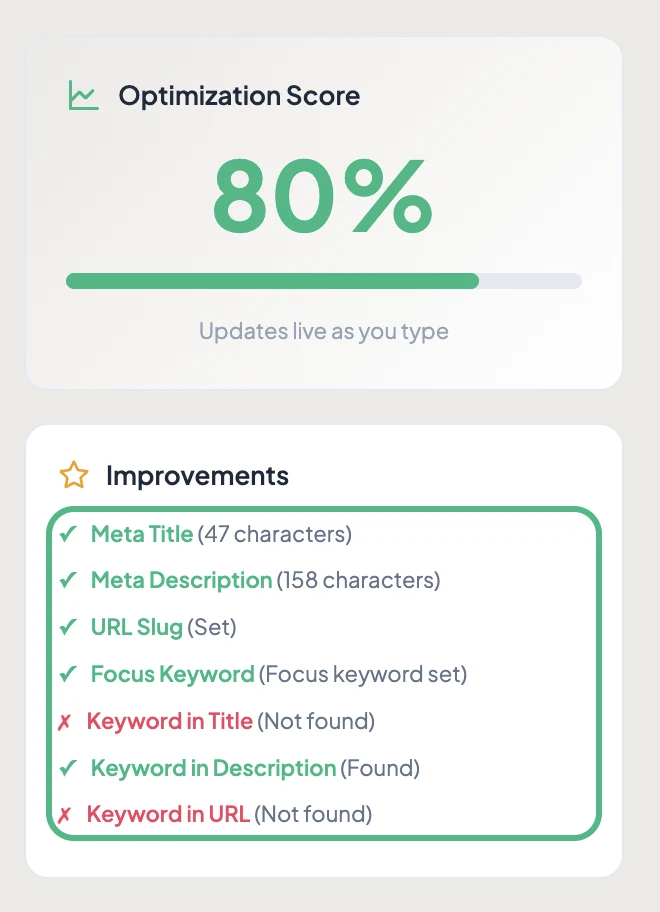
- in the SEO metabox when you edit a post or page
- as the site-wide average on TamRank → Dashboard
- in the SEO audit, where every analyzed page is listed with its score
TamRank reads the last saved score for each page rather than recalculating on the spot, so a page’s score updates when it is analyzed, not the moment you type. That is why the dashboard and the audit show the same figure for a page until you analyze it again.
What the score is made of
Your score comes from two things: your content and your meta. Content is the bigger part by far, because that is where readers and search engines spend their attention. Your meta, the title and description that show up in search results, makes up the rest.
A strong title cannot rescue a thin page, and good content with a missing title still leaves easy wins on the table. The score only reaches the top when both are in good shape.
What the bands mean
The number falls into one of four labels, so you can read a page at a glance:
- Excellent: 80 to 100
- Good: 60 to 79
- Needs attention: 40 to 59
- Improve: 0 to 39
Good is a solid resting place for most pages. Aim for Excellent on the handful that matter most, not on every tag archive.
Your content: the bigger part
Content is where most of your score is won or lost. TamRank looks at six things here, and they do not all count the same. In order of how much they matter:
- Headings and structure: one clear H1 that includes your keyword, with sensible subheadings under it
- Keyword usage: your keyword used naturally, early on and a few times through the page
- Links: at least one link to another relevant page of your own
- Readability: short paragraphs, a real introduction, sentences that are easy to follow
- Images: a picture or two, each with alt text
- Content length: enough words to genuinely cover the topic
Headings and keyword usage matter most, so start there. Links come next, and adding a single internal link is often the easiest win on the page. The full checklist behind each one is in Content analysis: how your score is built.
Your meta: the quick win
Your meta is the smaller part of the score, and usually the fastest to fix. TamRank looks at four things:
- Meta title: a clear title of the right length, with your keyword in it
- Meta description: a short, readable summary with your keyword in it
- Focus keyword: set one for the page, so TamRank knows what to check against
- Slug: a tidy web address that includes your keyword
Because these take only a couple of minutes to fill in, they are often the quickest way to lift a page that has none. How to write them well is in Meta titles and descriptions.
The quickest way to raise a score
Work in this order and you spend your effort where it counts:
- Write the meta title and description. An empty pair leaves the whole meta part of your score untouched.
- Fix the H1. One H1 per page, and let it contain your focus keyword.
- Add an internal link. At least one link to a relevant page of your own.
- Use your keyword naturally. Early in the page, in a subheading, and a few times through the body.
- Re-run the analysis and read the updated issue list.
For most pages the story is the same: the content is already decent, and the meta is empty. A page like that often sits in the Good band on content alone. Write a proper title and description and it usually climbs into Excellent, because you have picked up the whole meta part of the score in a few minutes.
Wherever the score flags something, click the issue in the metabox and TamRank shows you the exact recommendation, so you are never left guessing what “fix your headings” is supposed to mean.
Tip: do not chase a perfect 100
The score is a guide, not a grade. A page in the Good band is doing its job. Spend your time lifting the pages that earn or convert, and let low-value pages like tag archives sit where they are. A calm 70 across your important pages beats a frantic hunt for 100 on every URL.
Troubleshooting
The score did not change after I edited the page. Scores are saved when a page is analyzed, and the dashboard reads those saved values. Re-open the page, or run an audit, to refresh it.
My content is good but the score is low. Check your meta. An empty title or description quietly holds a page back, however strong the content is, because the meta part of the score is left on the table.
The dashboard score differs from the metabox. The dashboard shows the site-wide average of every page’s saved score, so one page’s number will not match the whole-site figure.
Frequently asked questions
What is a good SEO score in TamRank?
Anything in the Good band, 60 to 79, is solid for most pages. Excellent starts at 80. You do not need 100 to rank.
Why is my score low when my content is good?
Your score leans mostly on your content, with your meta making up the rest. A strong page with an empty meta title or description leaves that meta part unearned, which holds the whole score back.
How is my score worked out?
It comes from two things: your content, which is the larger part, and your meta. Content is judged on six areas, headings, keyword usage, links, readability, images, and length. Meta is judged on your title, description, focus keyword, and slug.
Does the score update automatically?
It updates when a page is analyzed, for example when you save after editing or run an audit. The dashboard then reads that saved score.
What is the highest score I can get?
- In practice, a consistent Excellent on the pages that matter is the real goal.
Related
- Your content in detail: Content analysis: how your score is built
- Your meta: Meta titles and descriptions
- See it site-wide: Understanding your dashboard
- Back to Documentation

