SEO advice ages badly, and it does it quietly. A WordPress SEO guide written in 2022 can look perfectly fine on the surface while carrying, buried three sections in, an instruction that is now flatly wrong. Nothing flags the rot. The article just sits there, still ranking on the strength of its age, still recommending a metric that no longer exists.
So this guide does two jobs. The first is to lay out what genuinely changed in WordPress SEO over the last couple of years, each change pinned to a primary source, so you can recognise stale advice the moment you meet it. The second, and I think the more useful one, is to be honest about what did not change, because most “SEO in 2026” writing badly overstates the churn and leaves readers chasing noise. This is the closing guide in the complete WordPress SEO guide cluster, so treat it as the part meant to keep the rest from going out of date on you.
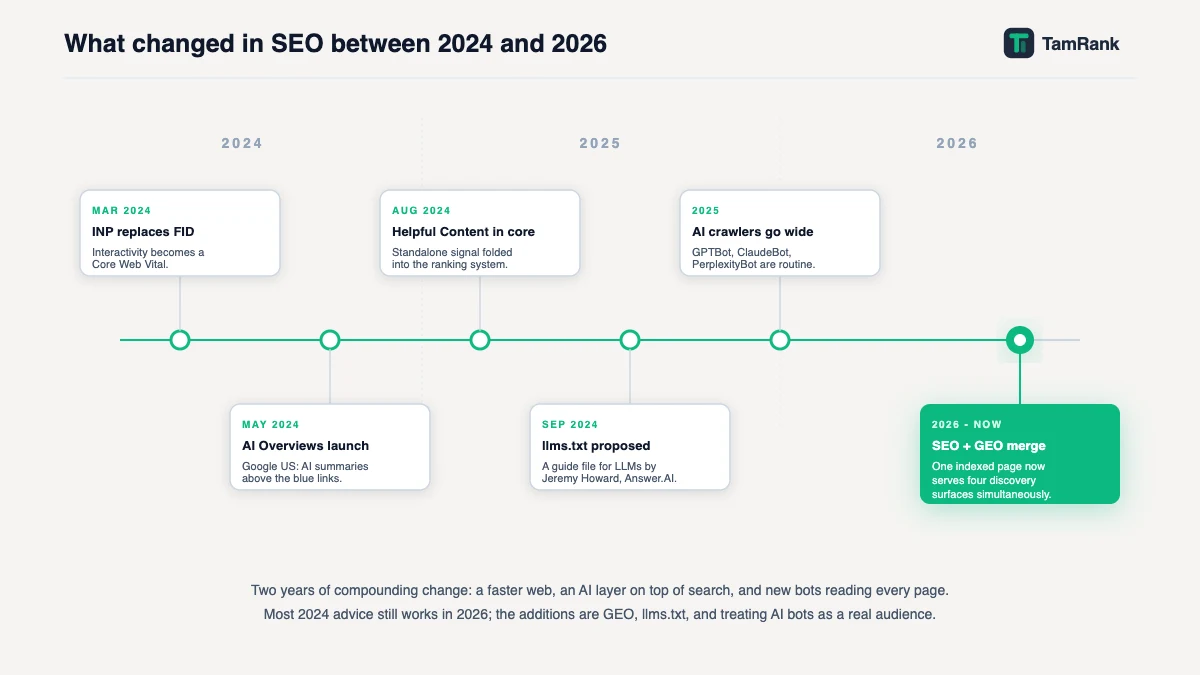
- In March 2024, INP replaced FID as a Core Web Vital. Any guide still telling you to optimise FID was written before then and never updated.
- The same month, the helpful content system was folded into Google’s core ranking. Helpfulness is now judged continuously, not in periodic updates.
- AI Overviews and AI Mode are the visible new layer on the results page, and they draw on the same indexed content as ordinary search.
- The fundamentals did not move: crawlable, useful, well-structured content plus patience still does the work.
- The real skill is filtering. Know what changed so you can drop stale advice, without overreacting to every “SEO is different now” headline.
Why SEO advice decays
Start with the mechanism, because it is the whole reason a guide like this needs to exist. SEO advice goes off in a way that is genuinely hard to spot. A blog post does not update itself the day Google changes something. It keeps its publish date, keeps ranking on the strength of its age, and keeps quietly handing out a tactic that stopped being true eighteen months ago.
So what you find online is a shelf of tins with the labels intact and half the contents expired, and nothing on the outside to tell the two apart. The defence is not to distrust everything you read, which is paralysing. It is to know the handful of specific things that changed recently, precisely enough that a dated instruction jumps out at you. The next three sections are those things.
Core Web Vitals: INP replaced FID
The cleanest example of an instruction gone stale sits in Core Web Vitals, Google’s set of page-experience measures. On 12 March 2024, Google swapped one of the three out. Interaction to Next Paint, INP, took over from First Input Delay, FID, as the metric for responsiveness, and Google pulled FID from Search Console the very same day.
The two measure responsiveness differently, and the difference matters. FID only ever clocked the delay before the browser started processing your first interaction, a single moment near the top of the visit. INP is broader and less forgiving: it measures the full lag between an interaction and the next visual update, across every interaction in the visit. It is a harder number to satisfy, and a more honest one.
For spotting dated advice, this is a gift. Any WordPress speed or Core Web Vitals guide that still tells you to “optimise your FID score” was written before March 2024 and left untouched since. FID is gone. It does not exist in Google’s tools any more. One mention of it is enough to date the whole article, and to make you read everything else in it with a raised eyebrow.
The helpful content system moved into core ranking
The second change is quieter than the first and, I would argue, more consequential. Google launched the helpful content system back in 2022 as a separate, named update, aimed squarely at sites stuffed with unhelpful, search-engine-first content. For roughly eighteen months it ran as its own classifier, a distinct thing that swept through now and then.
Then, in the March 2024 core update, Google folded it into the core ranking algorithm. The standalone classifier stopped running on its own. Helpfulness is now weighed continuously, as part of core ranking, all the time. Google said it expected that update and the related changes to cut low-quality, unoriginal content in results by around 40%.
The practical consequence is a shift in how you carry risk. There is no longer a periodic “helpful content update” to recover from or wait out, the way sites once sat tight through a storm. The assessment never switches off. A thin or derivative page is not safe in the gaps between updates, because for this there are no more gaps. It is one more reason the volume tactics in the SEO myths guide stopped paying: the system that marks them down is now always awake.
AI search arrived: AI Overviews and AI Mode
The most visible change of the three is the one sitting right on the results page. Google now shows AI Overviews, generated answers parked above the organic results, for a large share of queries, and offers AI Mode for the more open-ended, exploratory kind. Assistants like ChatGPT and Perplexity have quietly become a search surface in their own right.
The real change is that broad informational queries increasingly get answered without anyone clicking through, and there is now an AI layer where your content is either cited or invisible. But here is the non-change that matters just as much: AI search is not a separate machine bolted on beside search. Google’s own documentation is clear that AI Overviews and AI Mode draw on the same crawled, indexed pages as classic search, using a query fan-out technique to gather content. The page that earns a citation is a normally optimised page. What all of this means for the actual value of doing SEO is the whole subject of the does SEO still work guide in this cluster; here the point is narrower and worth stating plainly. AI search changed the shape of the results page. It did not change what feeds it.
This is also the easiest place to watch the decay this guide opened with. When llms.txt appeared, publishing a machine-readable summary of your site for language models looked like cheap insurance, and plenty of 2025 advice still says so. Then the measurements arrived. Ahrefs checked all 137,210 domains in its web analytics data for a live llms.txt, then looked at who actually requested the files it found: 97% received zero requests in May 2026, and no AI search bot fetched them at all. Google’s AI-features guidance states plainly that “You don’t need to create new machine readable files, AI text files, or markup to appear in these features.” TamRank shipped an llms.txt generator and then removed it in version 1.3.7. A tactic that was reasonable to try in 2025 is dead weight in 2026, which is this guide’s whole mechanism compressed into one file.
What changed on the WordPress side
Not every shift came from Google’s side of the fence. WordPress itself has moved, in ways that quietly change the SEO picture. Core gained native XML sitemaps in version 5.5, so every modern WordPress site ships with a sitemap and no plugin at all, though an SEO plugin still gives you a fuller one. The block editor has grown into the standard way pages get built, which makes clean heading structure and tidy markup easier to land than the old classic editor ever did. And recent versions redirect attachment pages to their parent post by default on fresh installs, quietly shutting one of the oldest taps of thin, empty pages, though older sites still carry the leak.
None of these is a headline on its own. Together, though, they mean a WordPress site set up today starts from a cleaner technical baseline than one set up five years ago. A fair amount of old WordPress SEO advice exists purely to patch problems the platform has since fixed for you.
What did not change
Here is the honest counterweight, and it is the section I would keep if I had to delete every other one. For all the genuine change above, the fundamentals of WordPress SEO did not move, and most “SEO in 2026” writing badly overstates how much did.
Google still finds sites by crawling links and reading sitemaps. It still rewards content that actually helps the person who lands on it. Internal links still tell Google how your pages relate to each other. Clear titles, sensible headings and a crawlable site still count for exactly what they always did. SEO still takes months rather than days. None of that shifted an inch. The changes are real, but they live at the edges: one metric swapped for another, one system relocated inside the algorithm, one new surface added to the results page. The core, useful content made legible to a crawler and given time, has been stable for years and stayed that way. The whole skill in 2026 is holding both facts in your head at once. Know what changed sharply enough to bin the stale advice, without letting every breathless headline stampede you into believing the entire game is new. It is not.
How to keep your own content current
The decay that rots everyone else’s advice comes for yours too. An article you wrote in complete good faith two years ago may be sitting there right now with its own dated instruction inside it. Keeping content current is part of SEO, not a separate bit of admin you get to skip.
The practical habit is a regular pass over your older, important pages. Read each one cold, as a stranger would, and ask the blunt question: has anything in here gone out of date, a metric that changed, a feature that moved, a statistic that has quietly aged? When you find one, fix it with a real refresh rather than a full rewrite. Treating a slow ranking slide as a possible content-currency problem, instead of assuming it is always the competition, is one of the more useful diagnostic habits you can build, and it is covered as content decay in the topical authority cluster.
A worked example: auditing an old guide
Take a WordPress speed guide published in early 2023, still pulling steady traffic, never once updated. Read it side by side with this article and the dated parts surface almost immediately.
It has a whole section headed “How to improve your FID score”, walking readers through a metric that has not existed since March 2024. That is not slightly behind; it is actively teaching people to optimise something Google deleted. Elsewhere it name-checks “the helpful content update” as a periodic event to brace for, treating as occasional a thing that now runs without pause. And it mentions AI Overviews nowhere at all, which for a 2023 article is a gap rather than a mistake, just a piece of the map that had not been drawn yet.
The fix is a refresh, not a teardown. The FID section gets rewritten around INP. The helpful-content line gets corrected to describe a system now living inside core ranking. A short, honest passage on AI search gets added. And the bulk of the guide, the parts on image compression and caching and clean markup, needs no touch at all, because those fundamentals never moved. That ratio, a few corrected passages set against a largely sound article, is what most real content audits actually look like.
How TamRank helps
Staying current is mostly a problem of noticing, and noticing is genuinely hard when the problem is a metric going quietly out of date rather than a red, obvious error.
We built TamRank around current standards rather than historical ones, which sounds obvious until you notice how much tooling still reports retired metrics. Its performance checks report on INP and the current Core Web Vitals, using real Chrome user data alongside lab data, so you are never polishing a metric Google has already retired. Its audit reflects how Google ranks content now, not in 2021. And for keeping your own pages current, the PRO Change Tracker logs when you edited a page and shows the search performance that followed, which turns a refresh into something you can measure instead of something you hope helped. You can install TamRank free or look over the feature list.
WordPress SEO in 2026 FAQ
What replaced FID in Core Web Vitals?
Interaction to Next Paint, INP, replaced First Input Delay on 12 March 2024, and Google removed FID from Search Console the same day. INP measures the full delay between a user interaction and the next visual update, across the whole visit, which makes it a broader and stricter responsiveness metric than FID ever was.
What changed with the helpful content system?
In the March 2024 core update, Google folded the helpful content system into its core ranking algorithm. It no longer runs as a separate, periodic update. Helpfulness is judged continuously now, so a thin or unoriginal page is not safe in the gaps between updates, because for this there are no more gaps.
What did not change in SEO?
The fundamentals. Google still crawls links and sitemaps, still rewards genuinely useful content, still reads internal links to understand your site, and still takes months to reflect changes. Most “SEO in 2026” coverage overstates the churn: the changes are real, but they sit at the edges of a core that has held steady for years.
How do I keep my WordPress SEO content current?
Review your older, important pages on a regular cycle and read each one as a stranger would, hunting for anything dated: a changed metric, a moved feature, an aged statistic. Fix what you find with a genuine refresh rather than a full rewrite. And treat a slow ranking decline as a possible content-currency problem, not only ever a competition one.
Is SEO being replaced by GEO in 2026?
No, the two run in parallel. GEO, Generative Engine Optimization, is the practice of structuring content so AI-powered search tools can understand, summarise and cite it accurately. The technical point that matters, confirmed in Google’s own documentation, is that AI Overviews and AI Mode draw on the same crawled, indexed pages as classic search. A site already well-optimised for SEO, crawlable, genuinely useful, clearly structured, is most of the way to GEO readiness. GEO simply adds attention to passage-level clarity and source-authority signals on top of that base. Starting GEO on weak SEO fundamentals does not work; the two build on the same foundation.
Should I still use WordPress for SEO in 2026?
Yes. WordPress powers around 43% of the web and stays one of the most SEO-flexible platforms going. It hands you direct control over every element Google cares about: URL structure, title tags, meta descriptions, canonical tags, schema, sitemaps, and page speed through your hosting and caching. Its plugin ecosystem keeps those SEO capabilities maintained and updated. Some hosted platforms have closed the gap on the basics, but WordPress still leads on extensibility and on the depth of its SEO tooling, including the option to run an open-API plugin like TamRank for programmatic access to your own SEO data.
The bottom line
WordPress SEO in 2026 changed in three concrete ways worth carrying with you. INP replaced FID as a Core Web Vital in March 2024. The helpful content system moved into core ranking that same month, so it now runs without pause. And AI Overviews added a new layer to the results page, fed by the same indexed content as before. Know those three precisely and you can spot the dated advice that still floats around unchallenged.
But the bigger truth is the one to hold onto. The fundamentals did not change. Crawlable, genuinely useful, well-structured content, given time, is what worked in 2020 and what works in 2026. Learn the changes so you can filter out stale advice, and ignore the headlines telling you to tear it all down and start over, because you do not need to. That is the closing note for this whole cluster: work through the WordPress SEO guide and its supporting articles, and the foundation you build will outlast the next round of changes just as easily. To work from a tool that stays current with how Google ranks today, install TamRank free.
Sources
- Google (web.dev), “Interaction to Next Paint becomes a Core Web Vital on March 12,” on INP replacing FID on 12 March 2024 and FID’s removal from Search Console. web.dev.
- Google Search Central, “What web creators should know about our March 2024 core update and new spam policies,” on the helpful content system being folded into core ranking. Google developer documentation.
- Google Search Central, “AI features and your website,” on AI Overviews and AI Mode using query fan-out, drawing on the same indexed pages as classic search, and not needing new machine readable files or AI text files. Google developer documentation.
- Ahrefs, “We Analyzed 137K Sites: 97% of llms.txt Files Never Get Read,” on llms.txt files receiving zero requests in May 2026 and no AI search bot fetching them. ahrefs.com.

