Every few years, someone stands up and declares SEO dead. Social media killed it, then voice search killed it, then the last big algorithm update killed it. Each time, SEO went to its own funeral and walked out fine. In 2026 the named cause of death is AI: AI Overviews answering questions inside the search page, and assistants like ChatGPT and Perplexity replacing the search box entirely for a slice of people.
It is a fair question, and it deserves an honest answer rather than doom or denial. Does SEO still work in 2026? Yes. But the easy, low-effort end of it does not, and pretending otherwise helps nobody. What lands in the TamRank inbox is rarely “is SEO dead”, it is “I did the SEO and nothing happened”, and the two questions share a root. This guide is the straight version: what AI search genuinely changed, what got harder, what quietly works better than before, and whether SEO is still worth your hours. It sits under the complete WordPress SEO guide.
- SEO still works in 2026. What stopped working is thin, low-effort content, which AI search has quietly made close to worthless.
- AI search runs on the same crawled, indexed pages as classic search. There is no separate index to optimise for.
- Broad informational head terms now leak clicks to AI Overviews. Specific, genuinely useful content keeps its traffic and gets cited.
- AI raised the floor. Mediocre content has no margin left; good content is worth more, because it is the scarce input both search and AI depend on.
- For most WordPress sites SEO is still the best long-term channel, if you can commit to depth and patience. Fast and low-effort it is not.
The short answer
SEO still works. What has changed is which kind of SEO works, and this shift is sharper than the scares that came before it.
Picture a floor being raised. For years, a certain amount of lazy SEO paid its way: a thin page aimed at a keyword, a quick definition article, content stitched together from other content. It was never good, but it ranked and it earned clicks. AI search has knocked the margin out from under that work, and the thin end of SEO is now close to worthless. Meanwhile the work that was always genuinely good, the useful, accurate, well-structured content a real person walks away better for, performs as well as it ever did, and honestly a shade better, because there is less competent competition crowding around it. SEO is not dead. The easy version is, and saying it that way is both more accurate and more useful.
What AI search actually changed
Be precise about what changed, because the panic rarely is. Two things are genuinely new, and both are worth naming plainly.
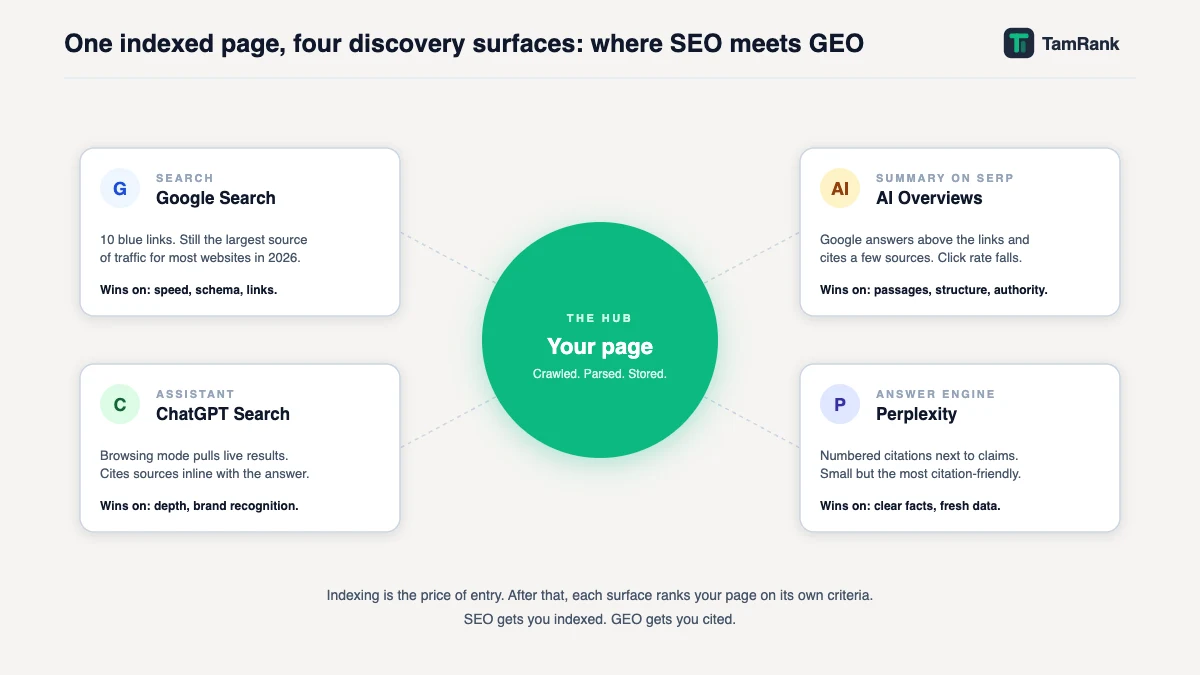
First, AI Overviews. For a lot of broad, informational queries, Google now writes an answer straight onto the results page. Ask “what is a meta description” and Google can hand it over on the spot, and no site gets the click. That is real, and it genuinely thins the traffic for one category of query. Second, AI assistants. A growing number of people now put their question to ChatGPT or Perplexity instead of searching at all, which is a fresh surface where you are either cited or simply not in the room.
Now hold two facts up against the alarm. AI search is not a separate machine bolted on beside Google. Google’s own documentation is clear that AI Overviews and AI Mode draw on the same crawled, indexed pages as ordinary search, using a query fan-out technique to pull content for the sub-questions inside a query. There is no second index to court; the page that earns a citation is a normally optimised page. And Google says these features open “unique opportunities for more types of sites to appear”, pointing people toward “a greater diversity of websites”. The pipe changed shape. It is still fed by the same SEO you already know.
What is genuinely harder now
An honest answer names the losses out loud. Two kinds of SEO are genuinely harder in 2026, and no amount of positivity changes it.
The first is ranking for broad informational head terms. If your traffic plan leaned on short, generic “what is X” queries, AI Overviews now skim a real share of those clicks off the top. The query still happens. The click, more and more, does not. The second is thin and derivative content of every flavour. A page that only re-states what ten other pages already say has no reason to exist the moment an AI Overview can re-state it faster and spare the reader the trip. The helpful content system, folded into Google’s core ranking since March 2024, was already leaning hard on exactly this kind of page, and AI search simply finished the job. If your SEO stood on either of those two legs, it is genuinely wobblier now, and there is no clever tactic that props it back up. The response is not a trick. It is to go and do the other kind of SEO.
One tactic deserves naming here, because it is sold hard as the answer to exactly this problem: the llms.txt file. The pitch is that publishing a machine-readable summary of your site at yourdomain.com/llms.txt gets you read by AI search. The measurements are in, and it does not. Ahrefs checked all 137,210 domains in its web analytics data for a live llms.txt, then looked at who actually requested the files it found: 97% received zero requests in May 2026, and no AI search bot fetched them at all. Google’s own AI-features guidance says the same thing up front: “You don’t need to create new machine readable files, AI text files, or markup to appear in these features.” We shipped an llms.txt generator in TamRank and took it out again in version 1.3.7, because a file nothing reads is not a feature, it is maintenance. That is what the raised floor looks like in practice. There is no file you can publish instead of doing the work.
What still works, and works better
The other kind of SEO is not merely surviving, it is thriving, so it is worth being exact about what “the other kind” actually means.
Specific, genuinely useful content still works, and it pulls clicks that AI does not intercept. The deeper guide to long-tail keywords lays out why: specific queries are too varied and too personal for a one-size summary, and Google’s own long-standing figure, that around 15% of daily searches have never been seen before, reaffirmed again in 2026, means a large and steady river of queries no system holds a canned answer for. Content built around real questions still catches those.
Depth across a whole subject still works too, and it is how you get cited rather than merely read. A query fan-out reaches out for content to answer the sub-questions of a query, and a site with genuine topical authority is one it reaches back to again and again. First-hand experience and demonstrable expertise have only climbed in value, because they are the one thing an AI cannot quietly synthesise from everyone else’s pages, and Google’s helpful-content guidance rewards them by name. Stack all of that up and the reframe is simple: AI did not lower the value of SEO, it raised the floor. It made thin content worthless and made genuinely good content scarcer, which is another way of saying more valuable. The work that was always the right work is now the only work that pays.
Is SEO worth the time investment?
“Does it work” and “is it worth my time” are two different questions, and the second deserves an honest tally of cost against benefit.
The cost is real, and I would rather be blunt about it than sell a dream. Good SEO in 2026 is slow, and it is not low-effort. It means genuinely useful content, published steadily, over months, before it starts to compound. The benefit is just as real, and it comes down to ownership. SEO traffic is an asset you actually own: once a page ranks it keeps bringing visitors with no per-click meter running, and a solid body of content goes on earning for years. Paid ads stop the instant you stop paying. Social reach is rented from an algorithm that can rewrite the terms overnight. SEO, done properly, is the one channel that quietly accumulates.
So here is the honest verdict. For most WordPress sites, SEO is still the best long-term channel, on a single condition: that you can commit to depth and patience. If you can produce genuinely useful content and sit tight for months while it compounds, it stays worth it, the more so now that the weak competitors are quietly dropping out of the race. If you need traffic this week, or you can only produce thin content, SEO is not your channel, and it is fairer to tell you that than to sell a quick win that no longer exists.
A worked example: two sites in the AI era
Two WordPress sites walked into 2026 both convinced they were doing SEO.
The first ran on sheer volume: a hundred short articles, each aimed at a keyword, each a competent re-statement of whatever already ranked. Through 2025 it drew a modest, steady trickle of traffic. Through 2026 that trickle thins toward nothing, because every one of those pages answered a broad question an AI Overview now answers on the page itself, and not one of them added anything an AI could not. There is no fix at the page level here. The site was built on the exact floor that got raised.
The second site published far less, maybe 25 articles across the same stretch, but each one answered a specific question with real depth and genuine first-hand detail. Its broad-term traffic dipped too, wherever AI Overviews showed up. But its specific, long-tail pages held their ground, it began turning up cited in AI answers for the sub-questions it covered well, and it picked up rankings for queries it never set out to target. Same eighteen months, same “SEO” label on the tin, opposite outcomes. The gap was never the effort spent. It was whether the content was the kind AI made worthless or the kind AI made scarce.
How TamRank helps
If the SEO that works in 2026 is the genuinely-useful kind, the practical danger is pouring effort into the kind that does not. That is a focus problem, and focus is exactly what a good tool should protect.
We built TamRank to point you at the work that still pays. Its audit and SEO score flag the things that genuinely matter, a thin page, a missing meta description, a crawl problem, and stay quiet about the busywork AI search has made pointless. It will not nag you to hit a keyword density or pad an article out to some word count. By keeping the signal clean, it keeps your hours on the content depth and clarity that both Google and the AI systems now reward.
It is part of the free plugin. You can install TamRank free or read through the feature list.
Does SEO still work FAQ
Is SEO dead?
No. SEO is not dead, and declarations that it is have been wrong for two decades. What has died is the low-effort end of SEO: thin, derivative content that AI search can now replace. Genuinely useful, well-structured content still ranks and still earns traffic.
Does SEO still work in 2026?
Yes. AI Overviews and AI assistants run on the same crawled, indexed pages as classic search, so good SEO still feeds them. Broad informational queries lose some clicks to AI answers, but specific, useful content keeps its traffic and gets cited in AI results.
Will AI replace SEO?
No, it reshapes it. AI search is a new surface fed by the same indexed content, so the work of being crawlable, clear and genuinely useful still applies. AI has raised the quality floor: thin content loses, and strong content becomes more valuable because it is scarcer.
Is SEO worth it for a small WordPress site?
Usually yes, on one condition: you can commit to depth and patience. SEO traffic is an owned asset that compounds, unlike rented paid or social reach. It is not worth it if you need traffic immediately or can only produce thin content, because that is exactly the kind AI search has devalued.
What is GEO and is it replacing SEO?
GEO stands for Generative Engine Optimization, the practice of structuring content so that AI-powered search tools, including Google AI Overviews, ChatGPT web search and Perplexity, can accurately understand, summarise and cite it. The short answer is that GEO complements SEO rather than replacing it. Both start from the same foundation: crawlable, well-structured, genuinely useful content. The difference is that GEO pays extra attention to passage-level clarity, since AI systems lift individual paragraphs rather than whole pages, and to source signals that make a site trustworthy enough to cite. For most WordPress sites, doing SEO properly already puts you most of the way to GEO readiness. The two overlap heavily at the fundamentals.
Do I need an llms.txt file?
No. Ahrefs checked 137,210 domains for a live llms.txt and found that 97% of the files it did find received zero requests in May 2026, with no AI search bot fetching them at all. Google’s guidance on AI features is explicit that you do not need to create machine readable files or AI text files to appear in AI Overviews or AI Mode. AI systems read the same crawled, indexed pages as classic search, so the work that pays is being crawlable, well structured and genuinely useful.
The bottom line
Does SEO still work in 2026? Yes, though the question hides a more useful one underneath it: which SEO still works. The answer is the SEO that was always the right kind. Specific, genuinely useful content, covered with real depth, written from actual experience, and made easy to crawl and easy to read. That work now performs better than it used to, precisely because AI search cleared out the weak competition standing next to it.
What stopped working is the stuff that never earned its place: thin pages, derivative re-statements, broad definitions with nothing added on top. AI did not kill SEO. It raised the floor and made the easy version worthless. For a WordPress site willing to do the real version, SEO is still the best long-term, owned channel going. For what specifically shifted in the search landscape this year, see the guide to WordPress SEO in 2026 in this cluster, and the WordPress SEO guide for the fundamentals. To keep your effort aimed at the work that still pays, install TamRank free.
Sources
- Google Search Central, “AI features and your website,” on AI Overviews and AI Mode drawing on the same indexed pages, the query fan-out technique, opportunities for more sites to appear, and the statement that no new machine readable files or AI text files are needed. Google developer documentation.
- Google, the figure that about 15% of daily searches are new, reaffirmed by John Mueller at Search Central Live, reported by Search Engine Journal, 2026. searchenginejournal.com.
- Google Search Central, “Creating helpful, reliable, people-first content,” on rewarding first-hand experience and expertise, and the helpful content system in core ranking. Google developer documentation.
- Ahrefs, “We Analyzed 137K Sites: 97% of llms.txt Files Never Get Read,” on llms.txt files receiving zero requests in May 2026 and no AI search bot fetching them. ahrefs.com.

