Ask “what is the best WordPress SEO plugin” and the honest answer is that there is not one. There is the best fit for the way you work, and a handful of capable plugins that each suit a different kind of person. Any article that crowns a single universal winner is usually either oversimplifying or quietly selling you something.
A disclosure before anything else: we build TamRank, one of the plugins in this comparison. That makes this article informed, not neutral, and you deserve to read it knowing that. What follows is still an honest comparison, concessions included, because a write-up that only flatters its own author is worth nothing to you. This guide sits under the complete WordPress SEO guide; for the separate question of whether to pay at all, the free versus paid guide in this cluster takes that on.
- There is no single best WordPress SEO plugin. The major options are all capable; the right one depends on how you work.
- No plugin ranks your site. A plugin handles the plumbing, titles, meta, sitemaps, schema. Content does the ranking.
- Yoast has the largest community, Rank Math the most generous free tier, AIOSEO the strongest e-commerce fit, SEOPress the lowest price, TamRank the clearest guidance.
- Install exactly one SEO plugin. Two at once produces duplicate tags and conflicting advice.
- Try the free version before paying. The best plugin is the one whose advice you will actually act on.
First, the honest truth: no plugin ranks your site
Before comparing anything, it helps to deflate the question a little. An SEO plugin does not rank your site. It cannot. What it does is handle the plumbing: control of your title tags and meta descriptions, an XML sitemap, schema markup, redirect management, on-page checks. All of that is necessary, and doing it by hand across a real site is impractical, which is the whole reason a plugin exists.
But the plumbing is not the building. Google’s own guidance is blunt that useful content influences rankings more than any other single factor, and no plugin writes that content for you or makes a thin page worth reading. This matters for the comparison because it sets the stakes honestly. The gap between the major plugins is real, but it is a gap of ergonomics, workflow and a few distinctive features, not the gap between ranking and not ranking. Choose well and you remove friction. Choose badly and you own a plugin whose advice you quietly ignore. Neither outcome is the whole game, which is worth holding in mind before you agonise over the choice.
The five plugins, honestly
Five plugins make up the serious field in 2026. Here is the real strength and the real weakness of each, with nothing airbrushed.
Yoast SEO is the original, and by a wide margin the most installed, running on more than 13 million sites. Its strengths are maturity and sheer ubiquity: the largest user community, the most documentation and tutorials anywhere, and a setup nearly every WordPress professional already has muscle memory for. Its weakness is the day-to-day experience. The free version keeps nudging you towards Premium, and the interface has put on weight over the years. With Yoast you are buying familiarity and a vast support ecosystem.
Rank Math is the fast-growing challenger, now past 3 million installs. Its strength is the free tier, which bundles things competitors charge for and is deeply configurable. Its weakness is the flip side of that strength: the breadth of options, hundreds of settings spread across many tabs, genuinely overwhelms non-technical users, and its AI writing features sit behind a separate subscription on top of the paid plan. With Rank Math you are buying power and configurability.
AIOSEO (All in One SEO) is past 3 million installs and built around tiered pricing. Its strength is breadth for commercial sites, with strong WooCommerce support and local SEO features. Its weakness is a more commercial feel, where several genuinely useful features are held back for the higher, pricier tiers. With AIOSEO you are buying e-commerce and local depth.
SEOPress is the quiet one. Its strength is value: a clean interface and the lowest-priced paid tier in the group. Its weakness is reach, a smaller community and fewer of the advanced features the others keep adding. With SEOPress you are buying a tidy, affordable, no-drama plugin.
TamRank, which we build, is the newest of the five. Its strength is clarity: it is designed to tell you exactly what to fix and how, in plain language, with the issues ranked by impact rather than dumped in a list. Its honest weakness is precisely its newness, a smaller community and fewer years of track record than Yoast or Rank Math. With TamRank you are trading an established ecosystem for guidance and a clean interface.
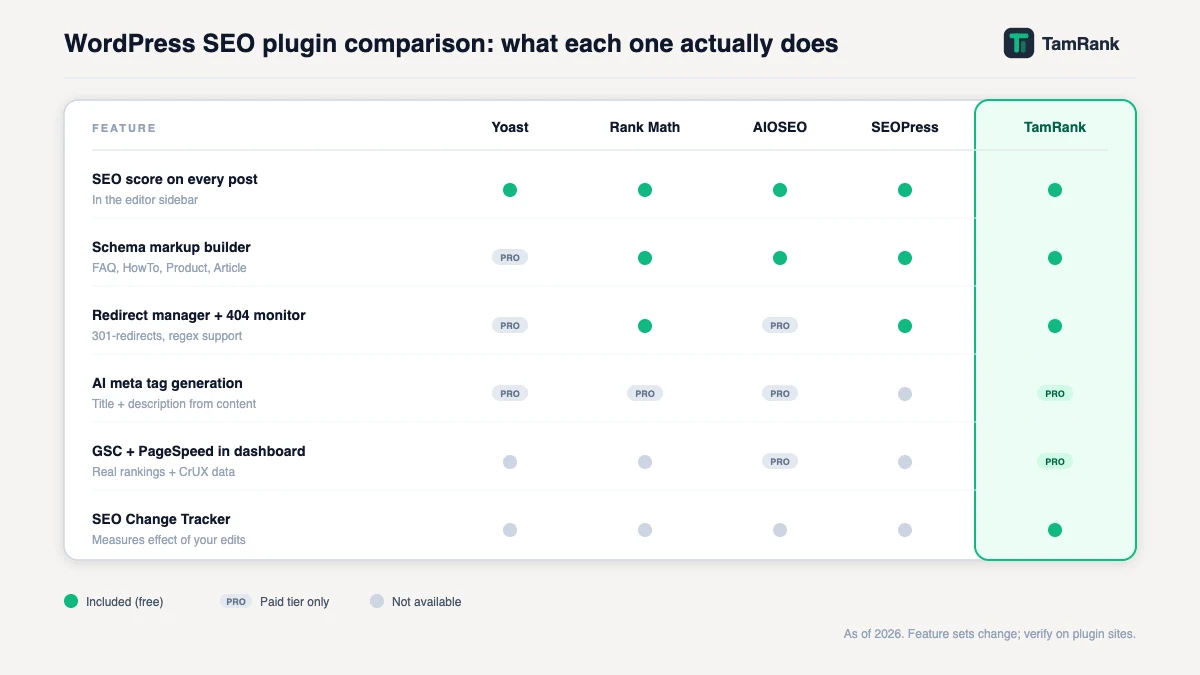
Feature comparison
A side-by-side view. Pricing is approximate and current as of 2026; always check the live price before buying, because every vendor moves it around.
| Plugin | Active installs | Free tier | Paid, approx. | Open API |
|---|---|---|---|---|
| Yoast SEO | 13M+ | Solid basics, frequent upgrade prompts | Premium around €99/year | No |
| Rank Math | 3M+ | Very generous, highly configurable | PRO around $96/year, AI billed separately | No |
| AIOSEO | 3M+ | Basic; much sits behind paid tiers | Tiered, roughly $50 to $600/year | Limited, higher tiers |
| SEOPress | Smaller | Clean, capable | PRO around €49/year, the cheapest | Limited |
| TamRank | Newer, smaller | 50+ features, no upgrade spam | PRO €99/year, AI credits included | Read free, write in PRO |
The table shows the differences, but it does not make the decision for you. The decision is about which of these suits the way you actually work, which is the next section.
One worth knowing outside the five: Smartcrawl, from WPMU DEV, keeps coming up whenever WordPress practitioners compare notes in community forums. Its free tier is capable and it runs cleanly on multisite. It lacks the install base of Yoast or Rank Math, and its advanced features need a WPMU DEV membership rather than a standalone plugin subscription, which makes any pricing comparison awkward. Worth a look if you already live in the WPMU DEV ecosystem, less obvious as a standalone pick.
What WordPress practitioners actually recommend
Expert comparisons and community consensus do not always line up, and it is worth knowing where they part ways. Across practitioner discussions in the WordPress community, a recurring pattern shows up: experienced users and developers skew towards Rank Math for its free-tier depth, and towards simpler or lesser-known plugins when they are building for non-technical clients, with Yoast treated as the safe default for clients who will Google for help. AIOSEO surfaces most often in e-commerce and local SEO threads. Plugins built around clarity, fewer settings and plainer feedback, tend to earn warmer word-of-mouth from owners who run their own sites rather than paying an agency.
The takeaway matches the rest of this comparison. Ask three different people and you can get three different winners, because the “best” recommendation shifts completely with who is recommending and what their day looks like. A developer building for clients has different priorities than a solo blogger, and both differ again from an agency running twenty sites. No single plugin wins across all three.
Which one fits you
The useful question is not “which plugin is best” but “which plugin is best for me”. Here is the honest match by type of site owner.
If you are a non-technical blogger or content creator, your priority is clear guidance without a wall of options. Rank Math’s configurability works against you here; AIOSEO’s tiers add friction. TamRank is built for exactly this case, plain-language fixes and prioritised advice, and that is a genuine recommendation. Yoast is a fair choice too if the size of its help community reassures you, because as a beginner you will be searching for tutorials often.
If you are a developer building client sites, you want a clean handover and bulk control. An open API matters here, since auditing fifteen client sites by logging into fifteen dashboards does not scale. TamRank’s API, read access free and write access in PRO, is built for this, and so is SEOPress’s lighter footprint. Yoast and Rank Math have no real API, which is a genuine limitation for this use case.
If you run a WooCommerce or e-commerce site, AIOSEO has the deepest native commerce and local-SEO support, and that is a fair reason to choose it. TamRank and the others handle WooCommerce product schema competently, but if commerce-specific features are your priority, AIOSEO earns the look.
If you are an SEO professional or agency, you care about reporting, prioritisation and proving impact. This is where TamRank’s Priority Actions and Change Tracker are genuinely differentiated, and the API supports agency workflows. Rank Math is strong here too for its depth of control. Yoast Premium covers the basics but offers less in the way of impact measurement.
If budget is the deciding factor, SEOPress has the lowest-priced paid tier, and every plugin here, TamRank included, has a free version that covers what most sites need. Nobody has to pay on day one.
The one rule that beats the comparison
Whatever you choose, one rule outranks the entire comparison: install exactly one SEO plugin. Never two.
Two SEO plugins both write to the same WordPress meta fields and both output schema, so you end up with duplicated title tags, duplicated or conflicting structured data, and two sets of recommendations that argue with each other. It is like running two satnavs in the same car, each calling a different turn with total confidence. The result is worse than either plugin on its own. If you are switching from one plugin to another, use the new plugin’s import tool to bring across your existing titles, descriptions and redirects, then fully deactivate and delete the old one before you lean on the new one.
How to actually decide
Reading a comparison only takes you so far. Two practical steps settle it.
First, use the free version before paying a cent. Every plugin here has one, and a week of actually living with a plugin tells you more than any feature table. Watch one thing in particular: do you find yourself acting on the plugin’s advice, or clicking straight past it? The best plugin for you is the one whose recommendations you do not tune out. Second, do not over-think it. These are all capable tools, the cost of landing on the second-best fit is small, and the cost of endless deliberation is real. Pick the interface you find clearest, install it, and get back to writing the content that actually moves rankings.
A worked example: choosing in practice
A freelance designer runs a small WordPress blog for their studio and also builds sites for around eight clients a year. They are weighing the options.
For their own blog, the deciding factors are a clean interface and clear guidance; they have no appetite for managing two hundred settings. For the client sites, what matters is a tidy handover, no baffling setup wizard for each client to wrestle with, and ideally a way to check several sites without logging into each one. So they try the free versions of three plugins over two weeks. Rank Math is powerful, but its options sprawl, and they can already picture a client getting lost in it. Yoast is familiar, but the upgrade prompts would land on client sites. They settle on a plugin clean enough to hand to a non-technical client that also has an API for the multi-site checks, which for this profile points to TamRank or, at the budget end, SEOPress. The point of the example is the method, not the winner: they did not hunt for the “best” plugin, they wrote down how they actually work and matched a plugin to it.
Where TamRank fits
TamRank is built for people who want the essentials handled cleanly and want better guidance once the list of possible SEO work starts growing. The free plugin covers the WordPress foundation without turning every screen into an upgrade prompt. PRO is for the next problem: deciding which issue deserves attention, seeing the evidence behind it, reviewing the proposed change and following what happened afterwards.
TamRank is also the newest plugin in this comparison. It does not have Yoast’s ecosystem, Rank Math’s breadth or the long track record of the established products. Those can all be valid reasons to choose something else. The useful question is not which plugin has the longest feature list. It is which workflow you will actually trust and use.
If you are considering a switch, start with the sourced TamRank and Yoast comparison or the TamRank and Rank Math comparison. The migration guide shows exactly which settings TamRank can bring across before anything changes on the site.
Best WordPress SEO plugin FAQ
What is the best WordPress SEO plugin?
There is no single best one. The major plugins, Yoast, Rank Math, AIOSEO, SEOPress and TamRank, are all capable, and the right choice depends on how you work: Yoast for the biggest community, Rank Math for free-tier depth, AIOSEO for e-commerce, SEOPress for price, TamRank for clear, prioritised guidance.
Is Yoast or Rank Math better?
Neither is universally better. Yoast offers maturity, the largest community and the most documentation. Rank Math offers a more generous free tier and far more configurability. A non-technical user often prefers Yoast’s familiarity or a simpler plugin; a power user who wants everything adjustable often prefers Rank Math.
Do I need a paid SEO plugin?
Usually not, at least not at first. The free version of every major SEO plugin covers what most sites need. Paid tiers become worth it once you have a specific reason, such as AI features, extended Search Console history or an API. Start free and upgrade only when you hit a real limit.
Can I switch SEO plugins later?
Yes. Every major plugin has an import tool that migrates your titles, meta descriptions, focus keywords and redirects from another plugin. Run the import, confirm the data moved across, then fully deactivate and delete the old plugin. Never leave two SEO plugins active at once.
Is a free SEO plugin enough for WordPress?
For most sites, yes. A free SEO plugin handles meta tags, XML sitemaps, basic schema, an SEO score and the core on-page checks. That covers the fundamentals completely. Paid features add time-saving and advanced tools, but they are an upgrade, not a requirement for ranking.
Is WordPress still the best platform for SEO?
For most use cases, yes. WordPress gives you direct control over every element Google cares about: title tags, meta descriptions, URL structure, canonical tags, schema, sitemaps and page speed via your hosting and caching setup. That control, combined with a mature plugin ecosystem, makes it hard to beat for SEO flexibility. The main alternative argument is that some hosted platforms have closed the gap on the basics, but WordPress still leads on extensibility, and its plugin ecosystem means you are never waiting for a platform to add an SEO feature you need.
The bottom line
The best WordPress SEO plugin is the one that fits how you work, and in 2026 the field hands you five capable choices. Yoast for community and maturity. Rank Math for free-tier depth and configurability. AIOSEO for e-commerce and local. SEOPress for price. TamRank, which we build, for clear and prioritised guidance, with the honest caveat that it is the newest of the group.
Whatever you pick, hold on to the two rules that matter more than the choice itself: run only one SEO plugin, and remember the plugin is plumbing, not content. Try a free version, choose the interface whose advice you will actually follow, and move on. For the separate question of when a paid plan earns its keep, the free versus paid guide in this cluster is next, and the WordPress SEO guide covers the rest. To judge TamRank for yourself, install it free.
Sources
- WordPress.org Plugin Directory, Yoast SEO listing, for the 13M+ active install count. wordpress.org/plugins/wordpress-seo.
- WordPress.org Plugin Directory, Rank Math SEO listing, for the 3M+ active install count. wordpress.org/plugins/seo-by-rank-math.
- WordPress.org Plugin Directory, All in One SEO listing, for the 3M+ active install count. wordpress.org/plugins/all-in-one-seo-pack.
- Google Search Central, “SEO Starter Guide: The Basics,” on useful content influencing rankings more than any other factor. Google developer documentation.
- Google Search Central, “Creating helpful, reliable, people-first content,” on rankings following from content that serves people. Google developer documentation.

